The Chinese God of Marriage: Yue Lao and the Red Thread
In ancient China, marriage was not a choice. Parents decided. Matchmakers negotiated. So people looked for something else — an old man under the moon, holding a book of marriages and a ball of red thread.
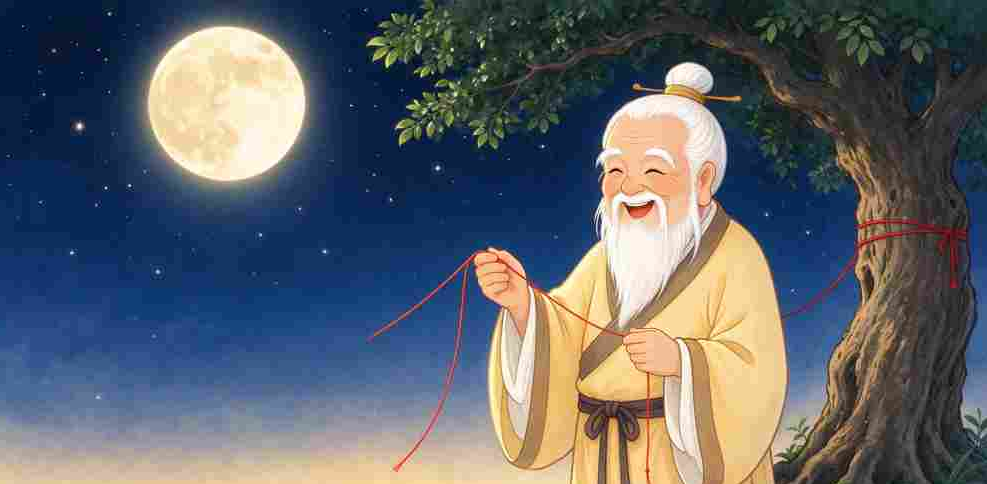
In ancient China, marriage was not a choice. It was decided by parents, by class, by money. So people looked for something else — a power that could override all of that. They found it in an old man under the moon.
In ancient China, marriage was not a choice.
A girl from a respectable family would spend most of her life inside the inner courtyard. She would not meet strangers. She would not choose her own husband. Her parents would decide, often with the help of a matchmaker. And on the day of the wedding, she would meet her husband for the first time.
So where did love come in? It didn't. Not in the way we think of it today.
But people still needed something to believe in. They needed to believe that, behind all the arrangements and negotiations, there was a force that knew what was right for them. That force had a name. It was Yue Lao — the Old Man Under the Moon.
1. Marriage in ancient China was not about two people
In ancient China, marriage was not about two people falling in love. It was about two families.
A girl from a wealthy or respectable family would live in the inner rooms of the house. She would not go out. She would not meet outsiders, and certainly not strange men. She did not know who she would marry.
That decision belonged to her parents. The phrase is fumu zhi ming — "the command of the father and mother." And between the two families, there had to be a matchmaker. That is meishuo zhi yan — "the words of the matchmaker."
What actually decided the marriage was status, family background, money, and official rank. The young couple had no say.
And on the wedding day, the bride and groom would meet for the first time. This was not an exaggeration. It was normal.
So in that era, marriage was a gamble that no one could control. Whether you ended up with a good person, or a difficult life, depended entirely on luck.
2. How Yue Lao appeared

Yue Lao first appeared in the Tang dynasty. There was a collection of stories called Continued Records of the Mysterious and Strange. One story in it is called "The Inn of Predestined Marriage."
The story goes like this. In the Tang dynasty, there was a young man named Wei Gu. He was unmarried. One night, outside an inn in Songcheng, he saw an old man sitting in the moonlight, leaning against a cloth bag, reading a book.
Wei Gu was curious. He asked the old man what he was reading. The old man said: "This is the book of marriages for everyone in the world." Wei Gu asked what was in the bag. The old man said: "Red thread. I use it to tie the feet of husbands and wives. Even if two people are enemies, or separated by a thousand miles, once the thread is tied, they will end up together."
Wei Gu quickly asked about his own marriage. The old man looked in the book and said his wife would be the three-year-old daughter of a vegetable seller north of the inn.
Wei Gu was angry. He thought the girl was too young and too ugly. He sent someone to kill her. The assassin only managed to wound her between the eyebrows.
Fourteen years later, Wei Gu married the adopted daughter of a provincial governor. She was beautiful — but she always wore a flower ornament between her eyebrows. When he asked why, he learned she was the same girl he had tried to kill. She had been wounded, and the ornament covered the scar.
Only then did Wei Gu believe: marriage is decided by fate.
3. Why the story survived
The core of this story is four words: yinyuan qian ding — "marriage is predestined."
In an era when marriage was completely out of your control, this idea was a comfort. It meant: no matter how your parents arranged things, no matter what the matchmaker said, no matter how far apart your families were — the red thread of fate would eventually pull you to the right person.
It turned an abstract feeling — "this was meant to be" — into an image you could see. Two people, with the same red thread tied around their ankles. No matter how far they walk, they will be pulled back together.
That is where the saying comes from: qian li yin yuan yi xian qian — "a thousand miles of marriage, tied by a single thread."
4. How Yue Lao became a god
Yue Lao started as a character in a Tang dynasty story. He was a nameless figure in the moonlight, with no clear identity. But later, Daoism formally accepted him.
There was a practical reason for this: Daoism does not reject marriage.
To understand why, you need to understand yin and yang.
Yin and yang are the most basic pair of concepts in Chinese philosophy. They are not "good and evil," and they are not simply "male and female." They describe something more fundamental: everything in the world is made of two forces that are opposite, and also dependent on each other. Day is yang. Night is yin. Summer is yang. Winter is yin. Without yin, there is no yang. Without night, there is no day.
In Daoism, yin and yang are not just a way of describing the world. They are an order. There is a Daoist saying: "Solitary yin does not grow. Solitary yang does not flourish." Only yin, or only yang, cannot survive. Both must be present for anything to grow.
So in Daoism, marriage is not a worldly matter. It is the way of heaven and earth. The union of man and woman is the union of yang and yin.
And because marriage is the way of heaven and earth, there needs to be a god who manages it. That god is Yue Lao.
Daoism gave him a title: "The God of Marriage and Predestined Unions." With that religious backing, Yue Lao went from a character in a story to a god in the pantheon.
His image also changed. He went from a vague "old man in the moonlight" to a kindly Daoist immortal.
5. Why so many people believe in him
Yue Lao's worship spread through temples and through stories of prayers being answered.
From the Song dynasty onward, temples to Yue Lao appeared in different cities. Today, there are Yue Lao temples in Hangzhou, Beijing, Taipei, and even Malaysia. These temples became a kind of spiritual outlet for single people. They go to Yue Lao, ask for a red thread, or ask for a good marriage.
And when someone actually finds a partner, they come back to give thanks — with wedding cakes, donations, or gold plaques. Those acts of gratitude become new "proof" that Yue Lao answers prayers, which brings even more people.
6. What Yue Lao really manages
Yue Lao does not really manage marriage.
He manages yuanfen — the idea of a destined connection.
In an era when you could not control your own marriage, the only thing you could rely on was a higher order. The red thread in Yue Lao's hand was stronger than your parents' arrangements, stronger than the matchmaker's words, stronger than the gap between families. It meant: no matter how the human world arranges things, the thread of fate will pull you to the right person in the end.
That is why, more than a thousand years later, Chinese people still pray to Yue Lao.
Find your element
Take the free Five Elements test