The Ladies of Xiguan: The Daughters of the Thirteen Factories
There is an old Cantonese saying: power lives in Dongshan, money lives in Xiguan. The money in Xiguan came from the Thirteen Factories. And the daughters of those merchants became the first women in Guangzhou to see the world.

There is an old Cantonese saying: power lives in Dongshan, money lives in Xiguan. The money in Xiguan came from the Thirteen Factories.
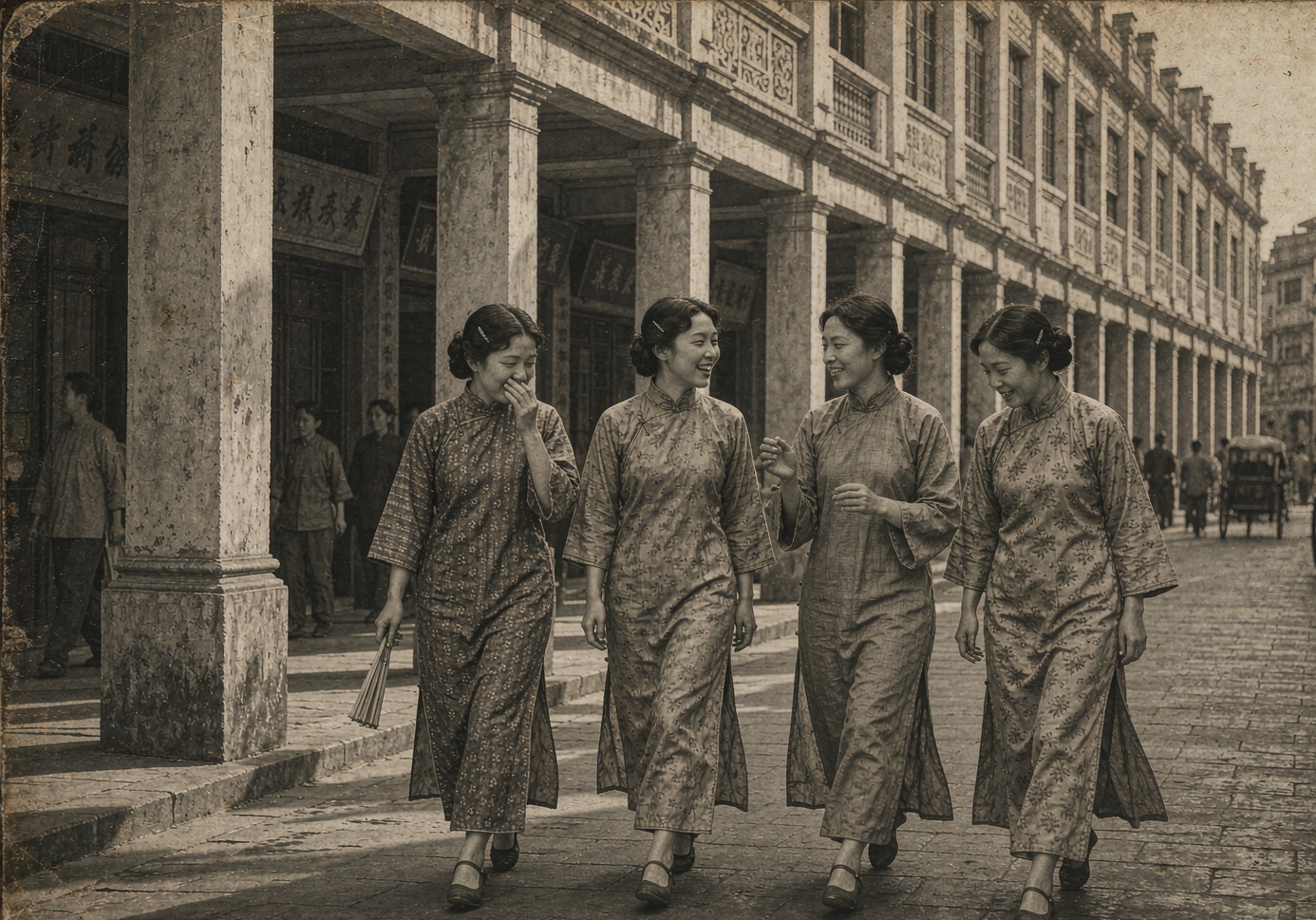
There is an old Cantonese saying: power lives in Dongshan, money lives in Xiguan.
The money in Xiguan came from the Thirteen Factories.
What were the Thirteen Factories?
The Thirteen Factories were not thirteen shops. They were a group of merchant houses licensed by the Qing government to handle all foreign trade in Guangzhou.
In 1685, the Kangxi Emperor lifted the maritime ban and established the Guangdong Customs in Guangzhou. The following year, the government recruited wealthy merchants to trade with foreigners. These merchants became the hong merchants.
In 1757, the Qianlong Emperor ordered that foreign ships could only enter Guangzhou. This was the "single-port system." From that year on, Guangzhou was the only port in China open to foreign trade. All foreign trade was concentrated here. The Thirteen Factories controlled China's foreign trade for 85 years.
The hong merchants were not ordinary merchants. They had a half-official, half-commercial status. They handled customs declarations, taxes, and guarantees for foreigners. And they managed the foreigners on behalf of the government. Foreigners could not meet Chinese officials directly. Everything had to go through the hong merchants.
How rich were they?
Among the Thirteen Factories, there were four great merchant families: Pan, Lu, Wu, and Ye.
Wu Bingjian was the most famous. His firm was called the Ewo Hong. The Wu family started with tea. Their tea was once certified by the British as the best in China. Any tea with the Wu family stamp could fetch a high price on the international market.
How rich was he? By 1834, the Wu family's annual trade with British and American merchants reached several million silver dollars. With assets of 26 million silver dollars — roughly 5 billion yuan today — Wu Bingjian became the largest creditor of the British East India Company. When the East India Company had cash-flow problems, it often borrowed from the Wu family.
He also invested in the United States — railways, securities, insurance. The Ewo Hong became a truly multinational conglomerate.
Pan Shicheng was a descendant of the Tongwen Hong family. He made his fortune in salt and was one of the most influential scholar-merchants of the Thirteen Factories. In Lizhiwan, he built the Haishan Xianguan, a garden covering hundreds of mu. It was called "the finest garden in Lingnan." Inside was a great pool of a hundred mu, directly connected to the Pearl River. Lotuses bloomed in the water. Lychee trees filled the garden.
Haishan Xianguan was not just a garden. Pan Shicheng printed a large book series there — the Haishan Xianguan Congshu, nearly 500 volumes, of which almost a quarter were new-learning books. Euclid's Elements, Matteo Ricci's Practical Arithmetic, Benjamin Hobson's New Treatise on Anatomy — these Western scientific works were printed by Pan Shicheng and circulated throughout the country, leading the way.
Xiguan was where these hong merchants lived. Their houses were built in Xiguan — green brick, stone footings, tang long doors, Manchurian windows. These were the Xiguan mansions.
The Ladies of Xiguan were the daughters of these merchants
The "Ladies of Xiguan" were the daughters of these hong merchant families.
Their families were in foreign trade, so their horizons were naturally wide. Their lives were completely different from most Chinese women of that time.
They were educated. In the Qing dynasty, Guangzhou had more than 300 private schools, of which nearly 100 were for girls only — most of them in Xiguan. Most girls from Xiguan families received a good education.
They led the way. While most women were still confined to the inner chambers, the ladies of Xiguan were already reading, writing, learning English, and encountering Western things. They were the most "world-facing" group of women in Guangzhou at the time.
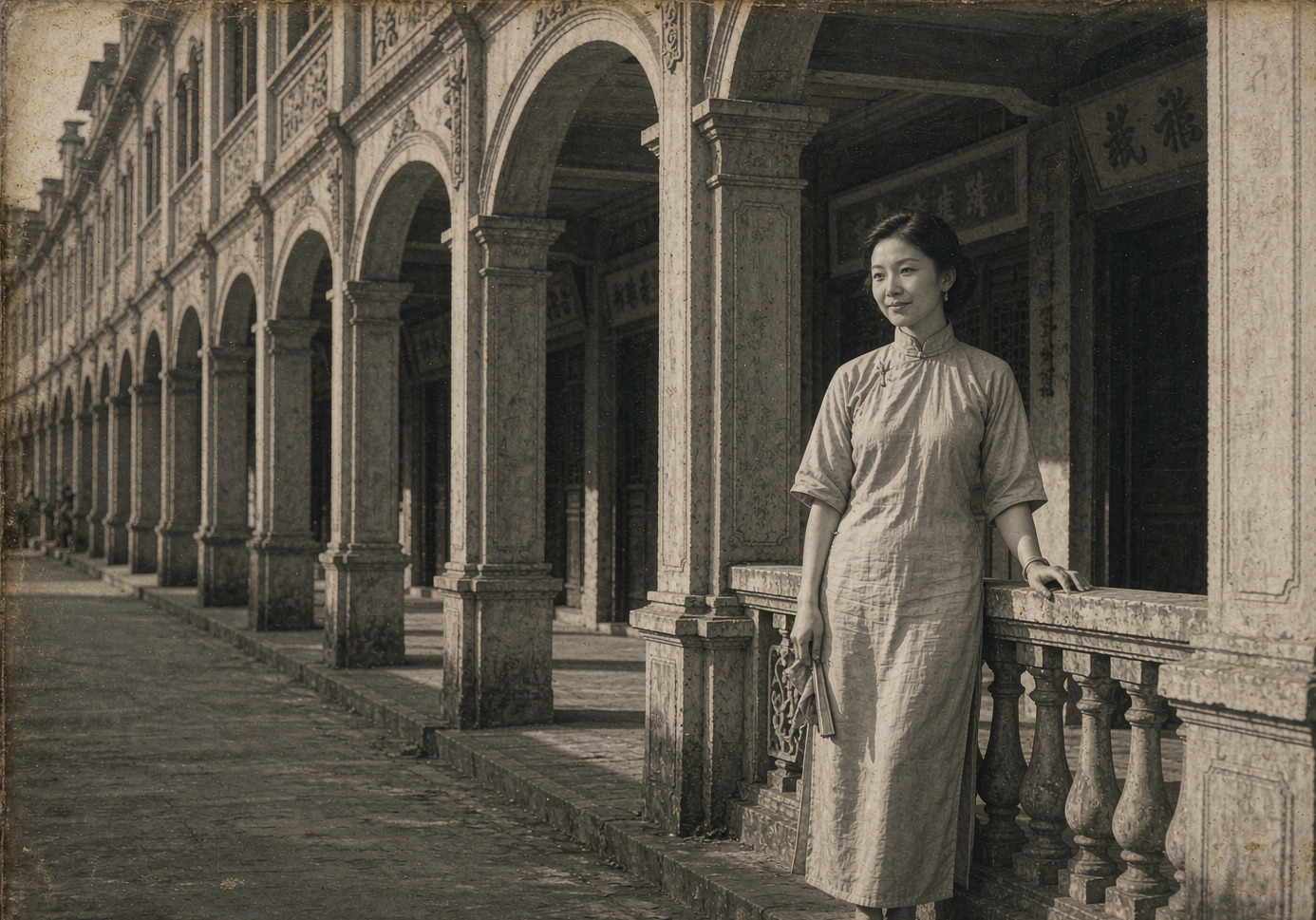
They and the Thirteen Factories were two sides of the same thing
The Thirteen Factories made Xiguan rich. And that wealth gave the ladies of Xiguan the conditions to study and see the world.
Their confidence came from the Thirteen Factories.
But they also influenced the Thirteen Factories in return. They were educated, and some participated in their family businesses. They were not decorative flowers locked in the inner chambers. They were women who grew up with this foreign-trade city.
What happened later
After the Opium War, the single-port system was broken. The Thirteen Factories declined, and the merchants' wealth scattered.
In 1856, British forces bombarded Guangzhou. The Thirteen Factories' merchant district was destroyed by fire, ending more than a century of prosperity.
Haishan Xianguan did not escape either. In 1873, Pan Shicheng was convicted and went bankrupt. The garden was divided up, and the famous garden was lost.
But the tradition of the ladies of Xiguan remained. Education, open-mindedness, seeing the world — these things did not disappear with the Thirteen Factories.
From the Thirteen Factories to the New China Building
The old merchant district of the Thirteen Factories is in what is now the Guangzhou Cultural Park area. If you go there today, you will see a green space called the "Thirteen Factories Trace Park." Inside is a section of "merchant house wall," recreating the Chinese-Western architectural facade of that time, and a shell-inlaid pavement that recalls the old Pearl River shoreline.
The Thirteen Factories did not disappear. It just continued in a different form.
Today, if you walk to Thirteen Factories Road, you will see a clothing wholesale street. Centered on Thirteen Factories Road, surrounded by Guyī Street, Yangxiang Road, Shisanhang Doulan Shang Street, and Heping East Road, it forms a clothing wholesale distribution center. The district has about 20,000 clothing stalls, with nearly 100,000 original new items released daily.
At its core is the New China Building. It was once known as "Asia's largest women's clothing wholesale market." In its peak period, daily foot traffic reached 100,000 people, and daily transactions reached 300 million yuan. There is a saying in the industry: "80% of China's clothing comes from Guangdong. 80% of Guangdong's clothing comes from Guangzhou. 80% of Guangzhou's clothing comes from the Thirteen Factories."
This is not retail. The customers are wholesalers from all over the country. Stalls open at 7 a.m. and close at 3 p.m. Goods are moved in and out in a very short time by handcarts and packing bags, with daily throughput exceeding a thousand tons. The carts, the noise, the crowds — that is how this district works.
The Thirteen Factories did foreign trade. Thirteen Factories Road does wholesale. The same name, the same business.
Closing
The wealth of Xiguan came from the Thirteen Factories.
The confidence of the Ladies of Xiguan came from the Thirteen Factories too.
They were the daughters of the hong merchants, and they were the first women in Guangzhou — this foreign-trade city — to open their eyes to the world.
Not sure which element is missing from your chart? Take the free Five Elements test at wuxingvibe.com/reading — it takes 60 seconds, and it tells you which stones are for you.
Find your element
Take the free Five Elements test