Why Real Crystals Have Cracks (And Fake Ones Don't)
A flawless, glassy crystal might actually be glass. Real stones grow for millions of years under heat and pressure, so they carry internal cracks, clouds and inclusions. These are not flaws — they are proof that the stone came from the earth.
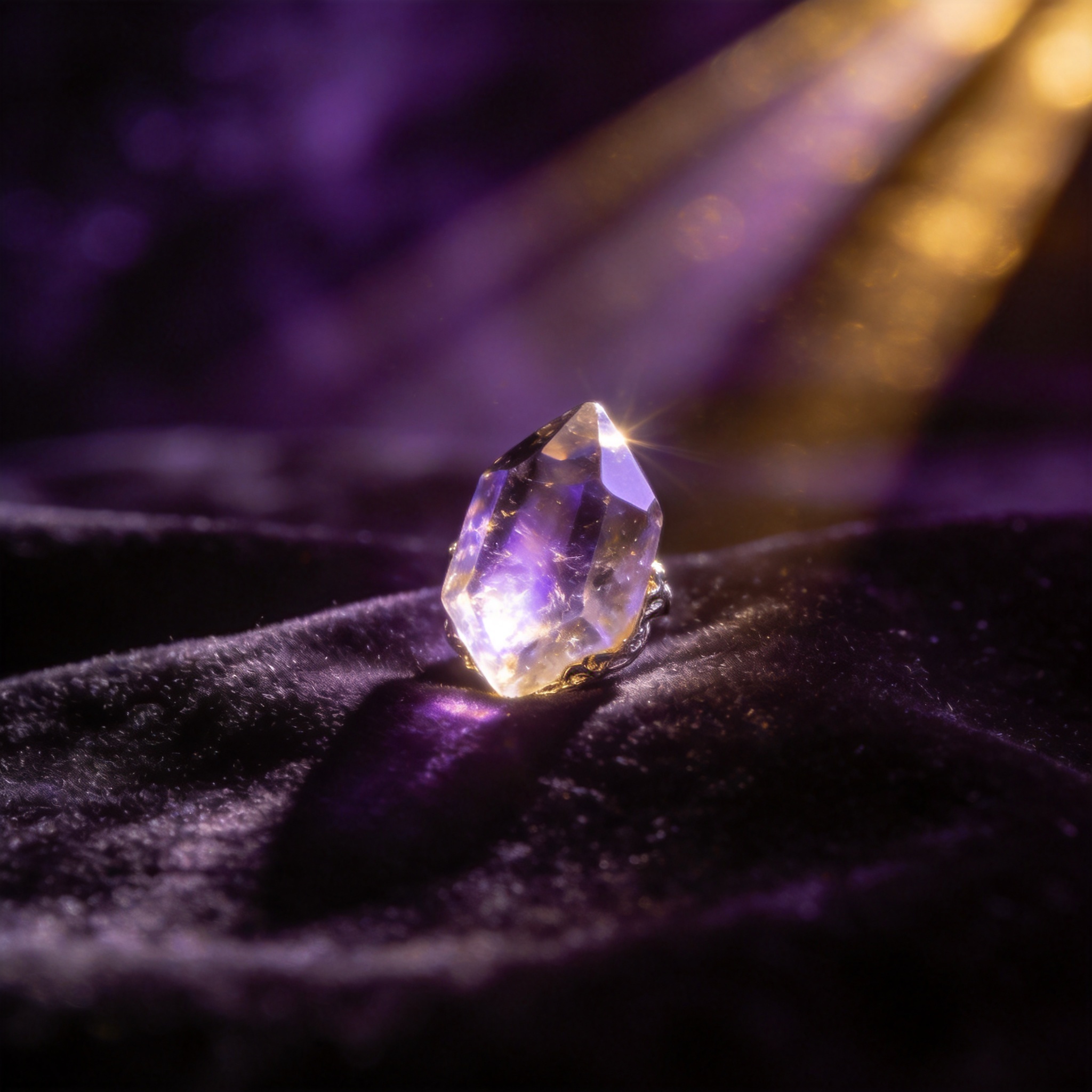
Have you ever held a crystal that felt almost too perfect? No marks, no cloudy lines, a surface so smooth it looks machine-made. In the world of natural stone, that perfect look is exactly what should make you pause.
One honest question
Walk through any crystal shop and you will see rows of stones. Some glow with a clean, even colour. Others have tiny lines, frosty patches, small specks trapped inside. It is tempting to reach for the flawless one — but among natural stones, perfection is often the first warning sign.
What natural stone looks like
Real crystals grow deep underground, for millions of years, through cycles of heat and pressure. As they form, they trap tiny gas bubbles, water, minerals and cracks. Gemologists call these internal clouds and fractures. You might hear them called 冰裂 (ice cracks) or 棉絮 (cotton clouds).
These marks are not damage. They are the stone's birth certificate. They tell you this piece was once molten mineral, squeezed and cooled inside the earth over geological time. A stone with character is a stone that has a real story.
What glass looks like
Take a piece of industrial glass or resin and it will look clean, uniform, weightless and cheap. Glass cools quickly and evenly, so it has no reason to crack or cloud. It is perfect because it was manufactured in minutes, not grown over millions of years.
That is why a too-perfect stone at a suspiciously low price is worth questioning. If it has no natural variation, no internal texture, no weight — it may never have been a stone at all.
The same test applies to dyed or treated beads. When a stone has been heated, dyed or glued together, it often looks unnaturally smooth and consistent. The eye loves uniformity, but the earth rarely makes anything perfectly uniform. If every bead on a string looks identical, produced with no variation at all, that is another small clue to pause and look closer.
Why I pick them by hand
Every strand I sell is chosen by hand in the Guangzhou crystal market. I look at every bead before it goes on the string. And here is the honest truth — if a stone is too perfect, I will not buy it. I will skip the glass-like bead and choose the one with natural cracks and clouds instead.
I would rather tell you the truth and lose a sale than sell you something that was never real. A stone with a small crack has a soul. A piece of glass has nothing to tell you. That honesty matters more to me than a quick sale, because a customer who trusts you comes back, and a customer who feels cheated never does.
The same logic as the Five Elements
Crystals and the Five Elements work the same way. Neither is about magic — they are tools for noticing what you lack and gently restoring balance. When your energy is out of balance, the right stone can help you feel steady again, the way a natural mineral found its own balance under the earth.
A slightly imperfect stone is not something to hide. It is something to be proud of. It proves that what you are holding came from the ground, not from a factory. And in the same way, your own rough edges are not flaws you need to fix before you are worthy — they are simply part of what makes you real.
Next time you shop for a crystal, do not reach automatically for the perfect one. Turn the bead over, hold it to the light, and look for the tiny cracks and cloudy lines that whisper "I grew here." That small sign tells you it is real. And a real stone, like a real friend, does not need to be flawless to be worth keeping. It just needs to be honest with you about where it came from.
Take the free Five Elements test to find your element.
Curious which element you need? Take the free Five Elements test to find your element.
Take the free Five Elements test →