Henan: The Most Misunderstood Place in Guangzhou
If you look at a map of Guangzhou's administrative districts, you won't find the word 'Henan'. But every local uses it. It's not the province in central China. It's the south bank of the Pearl River — a land of forgotten wealth, ancient temples, and heroes.
If you look at a map of Guangzhou's administrative districts, you won't find the word 'Henan'. But every local uses it.
If you look at a map of Guangzhou's administrative districts, you won't find the word "Henan."
Haizhu District, Yuexiu District, Liwan District, Tianhe District — those are the official names. But if you walk down the street in Guangzhou and ask a local, "Where do you live?"
If they live on the south bank of the Pearl River, they will almost certainly answer: "I live in Henan."
This "Henan" is not the Henan Province in central China. It means the south of the river — the south bank of the Pearl River.
Guangzhou locals call the north bank "Hebei" and the south bank "Henan." A child growing up in Haizhu District, when asked where they live, will say "Henan."
Interestingly, if you ask someone living on the north bank where they live, they won't say "Hebei." They will say "I live in Yuexiu," "I live in Liwan," or "I live in Dongshan."
Because "Hebei" is the default "city center." It doesn't need to be specified. But "Henan" is "the other side," separated by the river.
When someone from another province hears a Guangzhou local say "I live in Henan," they often freeze for a second: "Is your hometown in Henan Province?" The local then has to explain: "Not that Henan. The south of the river."
Today, "Henan" is huge. Anything south of the Pearl River — Haizhu District, and even parts of Panyu — locals collectively call "Henan." It's no longer a specific administrative name. It's the collective term for the entire south bank of the Pearl River.
For a long time, in the eyes of north-bankers, "Henan" was the countryside, a poor place. There were no bridges. You had to take a boat. When it rained, the streets flooded.
But if you actually walk into "Henan," you will find that this misunderstood land holds Guangzhou's richest gardens, its oldest temple, its most tragic hero, and its most vibrant street life.
1. Shuzhu Creek: The Forgotten "Rich District"
When "Henan" was at its poorest, it was also at its richest.
In the Qing dynasty, the hong merchants of the Thirteen Factories made a fortune in silver from the single-port system. They built grand mansions in Xiguan on the north bank. But their true back gardens were built in "Henan."
In the northwest of today's Haizhu District, there is a small creek that has now been covered with stone slabs and turned into an inner street. It is called Shuzhu Creek.
Shuzhu Creek connected to the Pearl River, providing convenient water transport. The world's richest man of the Thirteen Factories, Wu Bingjian, built the Wu Family Garden here. Another giant merchant of the Thirteen Factories, Pan Zhencheng, built the Pan Family Garden. These two gardens were massive, with pavilions, exotic animals, and rare plants. They were the top private gardens in Guangzhou at the time.
Back then, the Shuzhu Creek area in "Henan" was not poor at all. It was one of the most concentrated areas of wealth in Guangzhou.
2. Wu Bingjian: Rich Enough to Rival a Nation, Yet Could Not Leave the City
Wu Bingjian was the chief merchant of the Thirteen Factories. He made his fortune through a tea monopoly and networking. His firm, the Ewo Hong, was the largest. Any tea bearing the Wu family stamp could fetch a high price in Western markets.
How rich was he at his peak? 26 million silver dollars. This was roughly equivalent to half a year's fiscal revenue of the Qing government. In 2001, the Wall Street Journal listed him among the "50 Wealthiest People of the Last Millennium." He was the only pure merchant on the list.
You might ask: The Thirteen Factories were in Xiguan on the north bank. There were no bridges in the past. How did he "go home"?
Because he was rich. Ordinary people crossing the river had to wait for ferries, check the weather, and pay a fare. But he had his own private ferry. Every day, after finishing business with foreigners in the merchant district on the north bank, he got on his own boat, crossed the Pearl River, and returned to "Henan."
And because he was rich, he could find a quiet spot in "Henan" to build a massive mansion.
At that time, "Henan" was sparsely populated with vast wastelands. Everyone thought it was too remote, too troublesome to cross the river, and prone to flooding. But Wu Bingjian wasn't afraid of the trouble. He bought large tracts of wasteland and built the Wu Family Garden. He built the finest private garden in Guangzhou right in the countryside.
"Hebei" was where he made money. "Henan" was where he spent it.
But after the Opium War, with the Treaty of Nanking and five ports open, the monopoly was gone. He was forced to pay a massive share of the war indemnity. He wanted to move to America. His money was already invested there, but he could not leave. In 1843, he died in Guangzhou.
After he died, the garden he built in "Henan" was lost to fire and war. Today, if you go to Haizhu District, you can only find a "Miss's Building," a section of red sandstone wall foundation, and a stone in Haichuang Temple called "The Tiger Turning Its Head."
What happened to his money? Most of it was invested in America, given to his godson, John Forbes. The Wu family descendants received dividends from American railway investments for decades. But compared to those invisible railway stocks, the most real trace he left in America is a few portraits — to this day, in the old merchant mansions of Salem and Newport on the US East Coast, his portrait hangs on the wall, wearing Qing official robes and a queue.
He built the most beautiful garden in "Henan," and only a stone remains. He sent his money across the ocean, and it ended up as a portrait on someone else's wall.
3. Haichuang Temple: One of Guangzhou's Largest Buddhist Temples
Walking south along Shuzhu Creek, you reach Haichuang Temple.
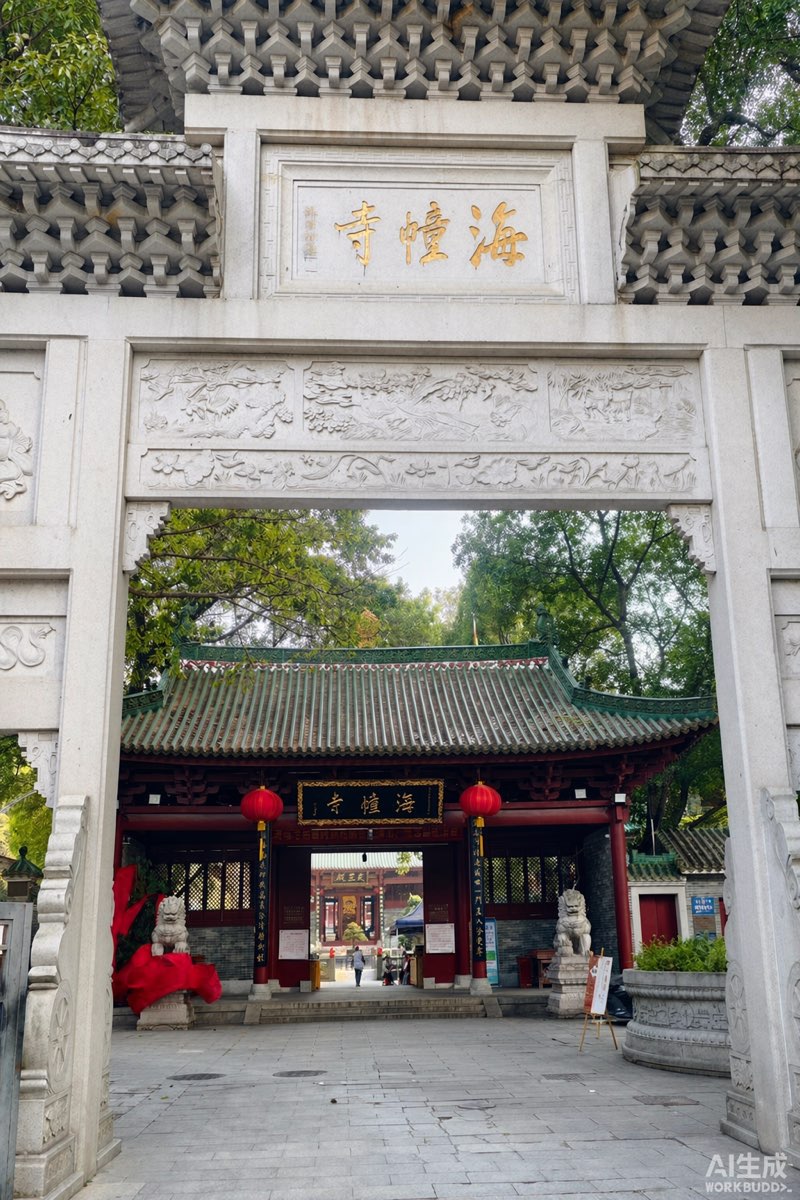
There is an old Cantonese saying: "Before there was Haichuang, there was Yingzhao." Haichuang Temple was first built in the Southern Han dynasty, originally named "Qianqiu Temple," and later destroyed in war. In the Qing dynasty, Pingnan Prince Shang Kexi built the Buddhist halls here, making it one of the Four Great Monasteries of Guangzhou (along with Guangxiao, Liurong, and Hualin).
In the temple, there is a Yingzhao Orchid (claw orchid) that is older than the temple itself. It was originally a tree in the Guo family garden during the Ming dynasty. When monks built the temple here later, the tree was kept. Today, if you visit Haichuang Temple, you can still see this centuries-old tree.
There is a tragic folk legend about this tree. It is said that in the Ming dynasty, this place was the garden of a wealthy man surnamed Guo. The Guo family had a maid named Lanxiang. One day, a jade button went missing, and the master suspected Lanxiang stole it. She was tortured. To prove her innocence, Lanxiang threw herself into a well and died. The Guo family filled the well. Later, a Yingzhao Orchid grew from the filled well, with flourishing branches. Later still, the Guo family declined, and the master died of a sudden illness. People said the tree was Lanxiang transformed. She suffered injustice in life, and after death, she turned into a tree to watch this family get their retribution. This legend gives the centuries-old tree a tragic layer of "good and evil will be repaid."
In the Qing dynasty, Haichuang Temple was not only a Buddhist holy place but also an official foreign affairs reception venue. When foreign merchant ships came to Guangzhou for trade, if they could not stay in the city, officials sometimes brought foreigners to Haichuang Temple for sightseeing and banquets. It witnessed the prosperity of Guangzhou as an international commercial capital.
4. Deng Shichang Memorial Hall: The Starting Point of a Hero
Near Shuzhu Creek, there is an old street called Longdaowei. This is where a tragic hero of modern Chinese history came from — Deng Shichang.
Deng Shichang was born in Panyu, Guangdong (now Haizhu District). His ancestral home is in Longdaowei. He was smart and studious from a young age. He later entered the Fujian Naval Academy and became one of China's first generation of modern naval officers.
In the First Sino-Japanese War, Deng Shichang was the captain of the Beiyang Fleet's Zhiyuan cruiser. On September 17, 1894, the Battle of the Yellow Sea broke out. The Beiyang Fleet encountered the Japanese Combined Fleet. The battle was extremely fierce. During the fight, the Zhiyuan was hit multiple times. The ship was listing severely, and ammunition was running out. Standing on the bridge, Deng Shichang shouted to the entire crew: "We join the military to defend the country, and we have long put life and death aside. Today, only death remains!"
At the critical moment of life and death, Deng Shichang made an extremely tragic decision: he ordered the Zhiyuan to go full speed ahead and ram the Japanese flagship Yoshino. He wanted to use his ship to perish together with the enemy.
Unfortunately, on the way to the enemy ship, the Zhiyuan was hit by a Japanese torpedo and exploded. The ship sank into the Yellow Sea, and Deng Shichang and over two hundred officers and men fell into the sea.
After falling into the water, his attendant handed him a lifebuoy. He refused to accept it. His pet dog, named "Sun," swam to him, bit his arm, and tried to drag him out of the water. Deng Shichang was determined to die with his ship. In the end, he hugged his dog, and they both sank into the waves.
He was 45 years old. When the Guangxu Emperor learned of this, he was deeply grieved and personally wrote an elegiac couplet: "Today the world sheds tears in vain; with you, the navy's prestige is truly strengthened."
Today, Deng Shichang's ancestral home in Longdaowei has been turned into the Deng Shichang Memorial Hall. That green-brick mansion sits quietly in the street life of "Henan." It reminds everyone who passes by: in this place once considered the "countryside," a true national hero was born.
5. Jiangnan Avenue North: The Most Romantic Street in China
If you walk east from Longdaowei and cross the Haizhu Bridge, you will reach a completely different street — Jiangnan Avenue North.
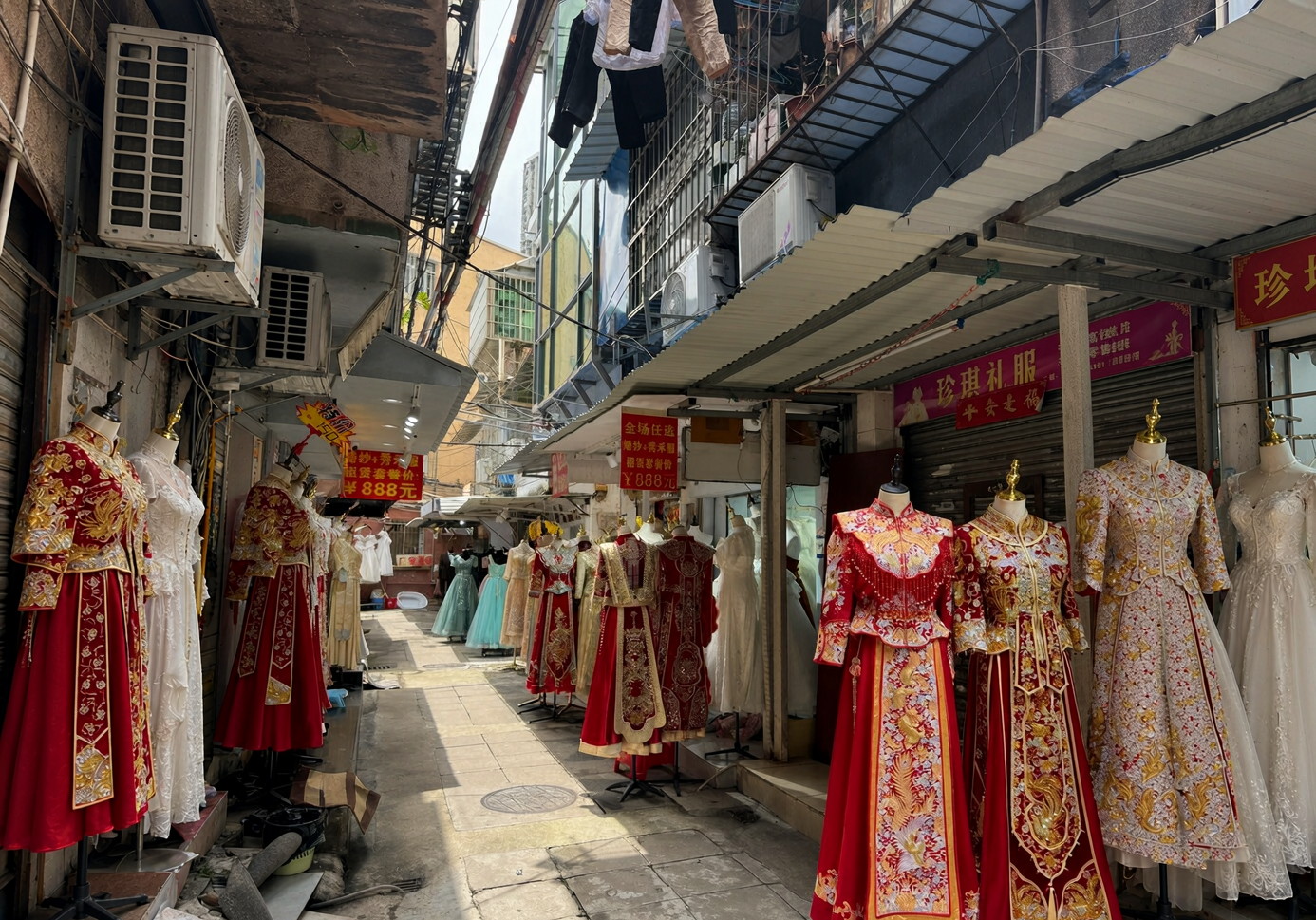
This is the largest wedding dress street in South China. Starting in the 1980s, hundreds of wedding dress shops gathered here. From traditional dragon-and-phoenix gowns and qipaos to Western white trailing gowns, you can find them all here. Every year, countless brides come to "Henan" in Guangzhou from all over the country to pick out a wedding dress that belongs to them.
Why is the wedding dress street here?
Because Jiangnan Avenue North was once one of Guangzhou's "Overseas Chinese Avenues." In the 1970s and 1980s, many returning overseas Chinese lived here and had many overseas connections. Seeing that Western wedding dresses were popular overseas, they put them out in their own gardens to sell. As more and more people bought them, it became a wedding dress street.
Over a hundred years ago, overseas Chinese brought red brick houses back to Dongshan. Decades ago, overseas Chinese brought wedding dresses to "Henan."
The prosperity here and the wealthy gardens of Shuzhu Creek centuries ago are two completely different worlds. But they are both "Henan."
Closing
Is "Henan" poor?
In the era before bridges, it was indeed the "countryside" separated by the river.
But "Henan" not only hides the secret gardens of the richest man of the Thirteen Factories, but also retains the footsteps of a hero of the First Sino-Japanese War. It has Haichuang Temple, one of the four great monasteries, and today it has the most romantic wedding dress street in China.
"Henan" is not the countryside of Guangzhou. It is the other half of Guangzhou's soul.
A note from us
We are not historians. We are people from Guangzhou who grew up with these stories. We share them for one reason: the East often looks mysterious, and sometimes frightening — but fear usually comes from not knowing. The more you know, the less there is to fear. And sometimes, the more you know, the more it can help you.
If you enjoyed this, you can reach out to us. You can also take our free Five Elements test — it takes 60 seconds, and it tells you which element you may be missing.
We hope everything goes smoothly for you. And if you ever come to China, we'd love to show you around.
Find your element
Take the free Five Elements test