Guangzhou: What 2,000 Years Have Left Behind
The city has been growing for more than 2,000 years. The walls moved. The river moved. But the center never did.
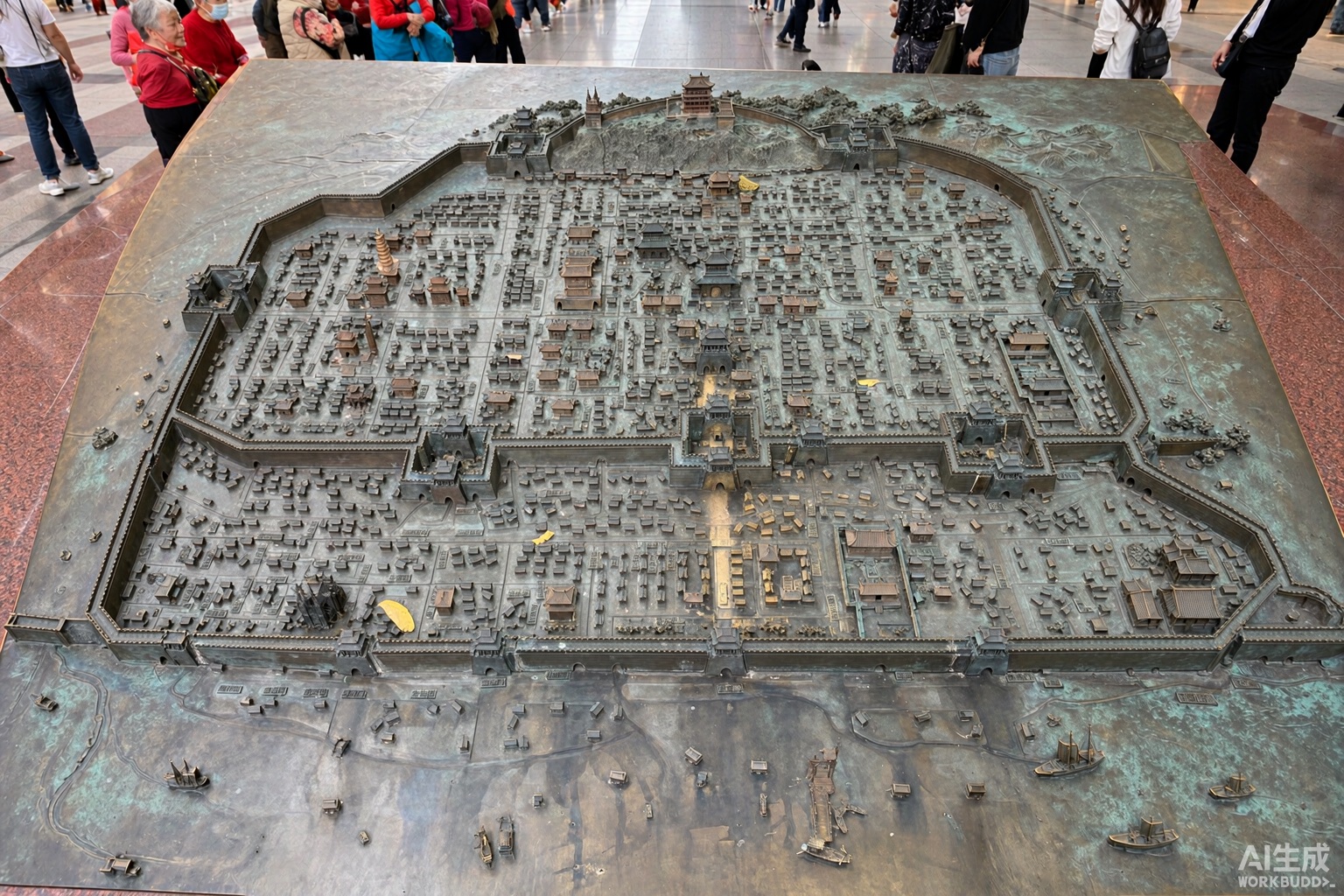
The city has been growing for more than 2,000 years. The walls moved. The river moved. But the center never did.

The city has been growing for more than 2,000 years.
The walls moved. The river moved. The dynasties changed. But the center never did.
This is what Guangzhou left behind.
214 BCE: the first city, on high ground by the river
In 214 BCE, after the Qin dynasty conquered Lingnan, the first governor of Nanhai Commandery, Ren Xiao, built a city between Panshan and Yushan. It was called "Ren Xiao's City." This was the beginning of Guangzhou.
Ren Xiao chose this spot because the Pearl River was much wider than it is today. Most of the area was mudflat and water. Only the high ground of Panshan and Yushan could hold a city — and it was close enough to the river for boats.
In 204 BCE, Zhao Tuo founded the Southern Yue kingdom and expanded the city to a circumference of ten li. It was called "Zhao Tuo's City." The Southern Yue palace stood east of today's Beijing Road. Archaeologists have found stone pools and paved floors there.
The Southern Yue wooden water gate is from the same period. In 2000, workers digging at the Guangming Plaza site found it underground. It was built on the north bank of the Pearl River, facing the water, to block tides and drain floods. Over the centuries, the riverbank moved south. The gate was buried in silt and covered by later buildings. It lay underground for more than 2,000 years.
When it was found, Guangzhou decided to preserve it in place. Today, you can take the elevator down to the basement of Guangming Plaza and see it.
Guangxiao Temple: older than the city itself
West of the city, there was also a temple. There is a Cantonese saying: Before there was Guangzhou, there was Guangxiao.
Guangxiao Temple began as the residence of Zhao Jiande, a king of the Southern Yue kingdom. In the Three Kingdoms period, the scholar Yu Fan was exiled to Panyu and moved into the old house. He taught in the garden and planted many hezi trees, so people called it "Yu's Garden." After Yu Fan died, his family donated the house and it became a temple. In the Eastern Jin dynasty, a monk named Tanmoyeshe arrived and built the Main Hall. That is when Guangxiao truly became a Buddhist temple.
Where the name "Ram City" comes from
There is a legend about the name Yangcheng — Ram City.
In the Zhou dynasty, the Guangzhou area suffered years of famine. One day, five immortals in five-colored robes, riding five rams with grain in their mouths, came down to the land. They gave the grain to the people, wished them a good harvest, and rose into the sky. The five rams turned to stone.
From then on, the people of Guangzhou built the Five Immortals Temple to remember them. That is why Guangzhou is also called Yangcheng — Ram City — and Suicheng — Grain City.
Tang dynasty: Arab merchants arrive, and the Light Tower rises
In the Tang dynasty, Arab and Persian merchants came to Guangzhou along the maritime Silk Road. They lived in the western part of the city, in an area called Fanfang — the foreigners' quarter.
They built a mosque there, the Guangta Mosque, first built in 627 CE. It is the oldest surviving mosque in China.
Inside is the Light Tower — Guangta. It has a cylindrical body, no tiers, and a small spire on top. It does not look like a Chinese pagoda. It looks like an Arab lighthouse.
Its purpose was to guide ships at sea. By day, a flag flew from the top. By night, a lamp was lit. Ships coming from the Indian Ocean, through the Strait of Malacca, into the South China Sea, sailed north. When they saw this tower, they knew they had reached Guangzhou.
At that time, the foot of the tower was the bank of the Pearl River. The merchants of Fanfang unloaded, traded, and lived here.
The mosque stayed. A thousand years later, the riverbank moved south. The tower is now far from the river, swallowed by the city. But the tower is still there. The mosque is still there. The name is still there. It is a mosque that has stood for more than a thousand years — and a place many Muslims come to see when they visit China.
From the Southern Dynasties to the Song: Liu Rong Temple, three cities, eleven layers of road
Besides the mosque, Guangzhou also had Buddhist temples. Liu Rong Temple was first built in the Liu Song period of the Southern Dynasties, originally called "Baozhuangyan Temple." Its core building is the Flower Pagoda — 57 meters tall, octagonal, nine stories outside, seventeen inside. It was originally wood, burned in the Southern Han, and rebuilt in brick and wood in the Song dynasty. The temple also has a Main Hall with three bronze Buddhas cast in 1663, each 6 meters tall and 10 tons. When Su Shi visited Guangzhou in the Northern Song, he saw six old banyan trees in the temple and wrote the two characters "Liu Rong" — Six Banyans. That is where the name comes from.
In the Song dynasty, Guangzhou built the Middle City, East City, and West City — the "Three Cities of Song." The walls finally enclosed the commercial district. The Beijing Road area became the city's central axis.
Under Beijing Road, there are eleven layers of pavement, from the Tang dynasty to the Republic. The top layer is Republican stone. Below it, Ming and Qing sandstone. Below that, Song and Yuan brick. At the bottom, Tang dynasty earth. Below the Tang layer is blue-gray silt — meaning that before the Tang, the northern section of Beijing Road was low-lying river land.
Along with the walls, large water projects were built: the South Moat as an inner harbor, the Jade Belt Moat as the southern city moat, and six canals inside the city.
The East Moat began as a natural stream from Baiyun Mountain, called "Sweet Stream." The West Moat was also a natural stream, dredged into a city moat when the West City was built in the Northern Song.
In 2024, the "Xiaomazhan–Liushuijing" site uncovered an Eastern Han city wall, with an Eastern Jin wall on top, and a Southern Dynasties wall above that. Three walls, stacked in the same place. The same site also revealed Tang and Song stone embankments, wooden dikes, and what may be a pier.
Ming dynasty: three cities become one, Zhenhai Tower, Dafo Temple, City God Temple
In 1380, the Marquis of Yongjia, Zhu Liangzu, merged the three Song cities into one, extended the wall north to Yuexiu Mountain, and built Zhenhai Tower on the mountain. It was the highest point in the north of the city, and for more than 600 years it has been the symbol of Guangzhou.
Dafo Temple was also expanded in this period. It was first built in the Southern Han, when King Liu Yan built it according to the positions of the 28 lunar mansions. Most of what you see today is a later reconstruction. In 1649, the temple burned. In 1663, the Pingnan Prince Shang Kexi donated his salary to rebuild it, enshrining three bronze Buddhas 6 meters tall and 10 tons each. That is how it got the name Dafo — Great Buddha. From 1996, the temple was gradually rebuilt over more than twenty years, following the traditional monastery layout.
Besides Buddhist temples, Guangzhou also had a City God Temple. It stands in the city center, not far from Beijing Road. It was first built in 1370. In the Ming and Qing dynasties, it was the largest City God temple in Lingnan. In the Yongzheng period of the Qing, it was promoted to the "Capital City God" overseeing the whole province. The temple enshrines three City Gods: the main deity is Liu Yan, founding emperor of the Southern Han; on either side are the Ming officials Hai Rui and Yang Jisheng. In the main hall there is also a giant lacquer mural, The Opening of Heaven and Earth: Scroll of the Immortals, depicting Pangu, Nüwa, the Three Pure Ones, the Five Sacred Emperors, and more than a hundred immortals. In 1920, when Guangzhou widened its roads, most of the front hall was demolished. Only the main hall and the worship pavilion remained. It was restored and reopened in 2010.
The East Moat became an official city moat in the Chenghua period. Governor Han Yong cut a channel through the Huanghuatang gorge, leading the Sweet Stream into the East Moat, creating a waterway five kilometers long.
Qing dynasty to the Republic: the center is still here
In the Qing dynasty, Guangzhou largely kept the Ming layout. The wall did not extend further north. No new gates were added. The city center was still around Beijing Road.
But the population grew, and new commercial districts formed outside the gates. Inside the walls were government offices and old streets. Outside were docks and shops.
This area has been the center of power in Guangzhou since the Qing dynasty. In the Qing, this was the Office of the Governor-General of Liangguang. After the 1911 Revolution, it became the Guangzhou Municipal Government. The building you see today was completed in 1931. After liberation in 1949, it became the office of the Guangzhou Municipal People's Government.
Across from it is People's Park. In the Qing dynasty, this was the back garden of the Office of the Guangdong Governor. After 1911, the governor's office was abolished and the land was left empty. In 1918, it was turned into First Park — the first modern public park in Guangzhou. The banyan trees in the park were planted in the Qing dynasty. They are older than the park itself.
What 2,000 years have left behind
The Southern Yue water gate is still under Guangming Plaza. Guangxiao Temple is still in the west of the city. The Light Tower Mosque is still on the old Fanfang site. Liu Rong Temple is still there. Zhenhai Tower is still on Yuexiu Mountain. Dafo Temple is still there. The City God Temple is still there. The Municipal Government Building is still there. People's Park is still there.
For more than 2,000 years, the city kept growing. Beijing Road and Yuexiu Mountain have always been the core.
The city changed. The center did not.
Not sure which element is missing from your chart? Take the free Five Elements test at wuxingvibe.com/reading — it takes 60 seconds, and it tells you which stones are for you.
Find your element
Take the free Five Elements test