Today, Let's Talk About the God of Wealth: The God Who Brings You Money
Chinese folk belief does not have one God of Wealth. It has a team. Some were generals. Some were merchants. Some were honest officials. Here is who they are, and why they became gods.
Many people say Chinese people have no faith. We do not pray every day. We do not go to temple every week. But that does not mean Chinese people believe in nothing. What Chinese people believe in is the Dao.
Many people say Chinese people have no faith. We do not pray every day. We do not go to temple every week. But that does not mean Chinese people believe in nothing. What Chinese people believe in is the Dao.
The Dao is not in the temple. It is in daily life. It is in how you do business, how you treat people, and where you draw the line. It is in every choice we make.
So today, we want to talk about the gods Chinese people believe in. And we start with the god who manages money: the God of Wealth.
In Chinese folk belief, there has never been just one God of Wealth.
Some were generals. Some were merchants. Some were honest officials. Each became a god of wealth for a different reason. But all of them point to the same idea: wealth should be earned fairly, and kept honestly.
Why are there civil and martial Gods of Wealth?
Chinese people divide the Gods of Wealth into civil and martial. This is not random.
- Civil Gods of Wealth represent fair trade and wisdom. They are worshipped by scholars, merchants, and people who want to make money through intelligence and honesty.
- Martial Gods of Wealth represent loyalty, protection, and the power to keep wealth safe. They are worshipped by soldiers, merchants, and people who want to protect what they have earned.
In short: the civil gods manage how you make money. The martial gods manage how you keep it.
1. The True God of Wealth — Zhao Gongming
Zhao Gongming is the most widely recognized True God of Wealth. He is also the head of the "Five Routes of Wealth."
But he was not always a god of wealth.
In the Jin dynasty text Records of Searching for Spirits, Zhao Gongming was a god of the underworld, in charge of taking lives. By the Eastern Jin dynasty, in Tao Hongjing's Declarations of the Perfected, he had become a plague god. If your family offended him, your family got sick.
So how did a plague god become a god of wealth?
Records of Searching for Spirits tells a story.
Zhao Gongming was once sent by the heavens to take the life of a man named Wang Youzhi. Wang was gravely ill and had already said goodbye to his mother. When Zhao Gongming's men arrived at his house, they found that he was an honest official with no extra wealth. They heard him say goodbye to his mother with such sorrow that they were moved by his honesty and filial piety. They did not take his life. Instead, they used a cup of water to cure his illness, and left him more than ten red brushes, telling him they could ward off disaster. Wang recovered.
From then on, people began to think: Zhao Gongming may control plagues, but he has a scale in his heart. He punishes the wicked, and protects the good.
By the Southern Song dynasty, texts described Zhao Gongming as "removing the wicked and eliminating violence, upright and intelligent, rewarding loyalty and protecting filial piety." He had changed from a ghost who took lives into a judge who upheld justice.
And it was this sense of justice that planted the seed for him to become a god of wealth. Because what business fears most is unfairness. And Zhao Gongming was in charge of fairness. By the Yuan dynasty, his duties included "explaining fairness, buying and selling for profit, and bringing harmony to trade."
The final turning point came in the Ming dynasty novel Investiture of the Gods. Jiang Ziya, following the command of the Primordial Lord of Heaven, gave Zhao Gongming the title "Golden Light and Auspicious Dark Altar True Lord," with the duty of "managing gold and silver, welcoming good fortune." From then on, he managed the wealth of the world, and became a god of wealth.
Zhao Gongming has four subordinates, together known as the "Five Routes of Wealth":
- Zhao Bao, Summoning Treasures — East
- Na Zhen, Gathering Precious Things — West
- Zhao Cai, Summoning Wealth — South
- Li Shi, Profitable Market — North
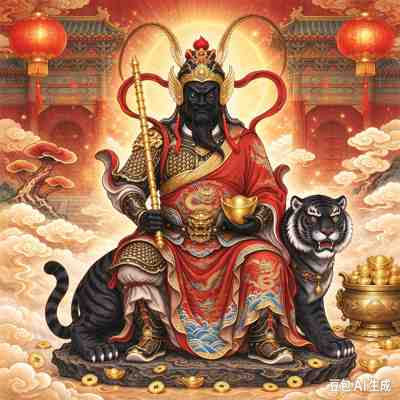
Zhao Gongming's image: black face, thick beard, iron crown, iron whip, riding a black tiger. That is why he is also called the "Dark Tiger of the Mysterious Altar."
2. Civil God of Wealth — Bi Gan
Bi Gan was the uncle of King Zhou of Shang, and a loyal minister.
He often advised the king directly, and the king hated him for it. One day, the king claimed that his favorite concubine, Daji, needed a "seven-holed heart" to cure her illness, and forced Bi Gan to cut open his own chest and remove his heart.
Bi Gan died.
But after his death, he became a god of wealth. The reason is interesting: because he had no heart.
"Having no heart" means "having no bias." In business, the worst thing is bias — cheating on weights, treating customers differently. Because Bi Gan had no heart, he was fair to everyone. That is why people made him a Civil God of Wealth, representing fairness in trade.
3. Civil God of Wealth — Fan Li
Fan Li was a general under King Goujian of Yue in the late Spring and Autumn period. He helped Yue destroy the state of Wu.
But he made a choice many people cannot make: he retired at the height of his success.
He saw that Goujian was a man who "could share hardship, but not share prosperity." So he gave up his official post and went into business, crossing the sea to the state of Qi. Through farming, raising livestock, and trading, he earned a fortune three times — and gave it away three times, to the poor and to his friends.
Later generations called him "Lord Tao Zhu," and worshipped him as a god of wealth. What he represents is not "how to make money," but "being able to make money, and being able to give it away."
4. Martial God of Wealth — Guan Yu
Guan Yu was a general of the Three Kingdoms, famous for his loyalty and righteousness.
His rise as a god of wealth is connected to merchants.
In the Ming and Qing dynasties, merchants began to worship Guan Yu. Why? Because he represented trust and honor — doing business with integrity, trading fairly. His loyalty stood in sharp contrast to those who would betray anything for profit.
Merchants admired his loyalty and honor, and promoted him as a Martial God of Wealth, hoping the business world would build its order on trust. That is how Guan Yu went from a general to the protector of merchants.
5. Civil God of Wealth — Li Guizu
Li Guizu was a county magistrate during the Northern Wei dynasty, serving in Quliang County (in what is now Hebei).
He was upright, honest, and cared for the people as if they were his own children. After he died, the people built a shrine for him.
In 926, during the Later Tang dynasty, he was granted the title "Lord of Increased Fortune." The Yuan dynasty later gave him the title "Lord of Blessing and Fairness."
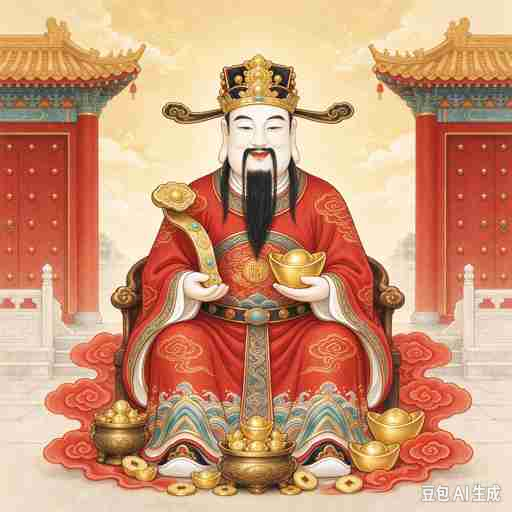
In folk art, Li Guizu is the most common image of the Civil God of Wealth: white face, long beard, brocade robe, jade belt, holding a ruyi scepter in one hand and a gold ingot in the other, with the words "summoning wealth and treasures" beside him. The God of Wealth on paper money during the Qing dynasty and the Republic of China was mostly him.
6. Other Gods of Wealth
Chai Rong: Emperor of the Later Zhou dynasty. He cared deeply about the people. He came from a fallen family and made his start in business. After taking the throne, he built waterworks, opened markets, and had statues of farmers carved and placed in the palace to remind himself of the people's hardships. During the Song and Yuan dynasties, people of the Central Plains began to worship him as a god of wealth. There is even a New Year print titled "King Chai Pushes the Cart, Gold and Silver Fill the House."
Wang Hai: Ancestor of the Shang dynasty. He invented the ox cart and started barter trade. He drove cattle and sheep, carrying goods to other tribes to trade. Those tribes called them "Shang people" — and that is where the Chinese word for "merchant" comes from. He is honored as the "ancestor of Chinese commerce," and is also known as the "Central Wealth God."
Zi Gong: A disciple of Confucius who became rich through business. He was the wealthiest among Confucius's students. Sima Qian wrote that he "rode in carriages drawn by four horses, and brought silk and coins to meet with feudal lords" — and the rulers of every state he visited treated him as an equal. He believed in "the gentleman loves wealth, but earns it the right way." The business ethics later known as the "legacy of Duanmu" refer to the honest trading culture he left behind.
Liu Haichan: A Daoist figure, and the main character in the story "Liu Hai Plays with the Golden Toad." Legend says he used a string of copper coins to tease a three-legged golden toad. Every step the toad took, it spat out a coin, which Liu Haichan gave away to the poor. People therefore see him as a "quasi God of Wealth." Statues of "Liu Hai Plays with the Golden Toad" are common in shops, symbolizing the summoning of wealth.
Closing
These gods became gods not because they were rich. They became gods because they were fair, honest, wise, or generous.
In Chinese folk belief, wealth is not just money. It is also character.
Find your element
Take the free Five Elements test