Foshan's Feng Shui History: A City That Balanced Fire and Water
Foshan was once the iron-smelting center of southern China. Furnaces burned day and night. So the city built a temple to a water god. This is the story of how a city balanced fire and water.
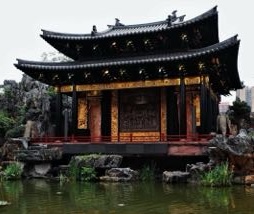
Foshan is a city in Guangdong Province, in southern China. Since the Song dynasty, it has been a center of industry and commerce — particularly iron smelting and ceramics. And for centuries, its survival depended on balancing two forces: fire and water.

Foshan is a city in Guangdong Province, in southern China. It sits in the Pearl River Delta, a region crisscrossed by rivers and waterways. Since the Song dynasty, Foshan has been a center of industry and commerce — particularly iron smelting and ceramics. It was one of China's "Four Great Towns" in the Ming and Qing dynasties, a place where goods were made, bought, and shipped across the empire.
Zumiao, the Ancestral Temple, is the city's most famous building. Its full name is the Temple of the Northern Emperor, or Lingying Shrine. It was first built during the Northern Song dynasty, around 1078–1085, and rebuilt in 1372 after being destroyed in war. Over the centuries, it was expanded and renovated many times, reaching its present form in 1899.
A water god in a city of fire
The temple is dedicated to Beidi — the Northern Emperor, also known as the Dark Warrior. In Daoist belief, Beidi is a water god. He rules the north, commands the water tribes, and controls floods and rain. For a city like Foshan, which depended on rivers for transport and was threatened by floods, a water god was a natural object of worship.
But there was another reason Foshan turned to a water god. From the Song dynasty onward, Foshan was the iron-smelting center of Lingnan. The city was full of furnaces burning day and night. Iron production meant fire — constant, intense, dangerous fire. And fire meant the constant threat of conflagration.
In the logic of the Five Elements, water controls fire. The people of Foshan needed water to balance the fire of their furnaces. The historical record makes this explicit: the Record of the Renovation of Lingying Shrine states that Foshan was "a land of fire in the south," and because its people made their living by casting and smelting, "the intensity of fire was extreme," so "the power of water was also especially needed to balance it." A water god in a city of fire was not superstition. It was risk management.
The pool and the stone turtle
Inside the temple, there is a pond called the Jinxiang Pool. In its center sits a stone sculpture of a turtle and a snake — the symbols of Beidi, the Dark Warrior. The pool serves a practical function as a water source for firefighting, but it also carries symbolic weight: water, contained within the temple, holding the fire of the city in check.
The temple's position in Foshan life was cemented in 1449, when a rebellion led by Huang Xiaoyang threatened the city. The townspeople prayed at the temple, and the attack was repelled. The victory was attributed to Beidi's intervention. The emperor then officially granted the temple the title "Lingying" — "Spiritual Response" — and it became a state-recognized center of worship. From that point on, Beidi was not just a water god. He was the protector of the city itself.
The Tangzai Stone
Inside the main hall of Zumiao, there is a large bronze mirror cast during the Jiajing period of the Ming dynasty. Below the mirror, on the central axis of the hall, lies a slab of dark marble. It is smooth and black, with faint white veins running through it. People call it the "Tangzai Stone" — the "Stone of the Slaughtered Boy."
The stone was originally placed there for a different purpose. After the temple was granted the title Lingying in the Ming dynasty, local officials used it as a "worship stone" — a slab to kneel on when they performed sacrifices to Beidi.
But the stone carries a nickname that comes from a folk story. According to the tale, a poor boy and his widowed mother lived near the temple. A local landlord accused the boy of stealing one of his geese. The boy, who had a stutter, tried to say he had eaten luo — snails — but in the local dialect, luo sounded like goose. The landlord took him to court and won, because he had bribed the magistrate. The mother, desperate, brought her son to the temple and asked Beidi to judge the case. The story says she laid the boy on the stone and cut him open to prove his innocence, and the crowd saw only snail meat in his stomach. Beidi then brought the boy back to life, and the landlord was punished.
The stone remains in the temple today, dark and smooth. Visitors walk past it without always knowing what it is. But the name — Tangzai Shi — stays.
The Water Gate
Not far from Zumiao, at the confluence of the Fen River and the Foshan Waterway, there is another temple. It is called the Waterfront Guandi Temple, first built in 1651.
Guandi is the Emperor Guan, a deified general from the Three Kingdoms period, worshipped as a god of loyalty, righteousness, and — for merchants — honesty in business. The Waterfront Guandi Temple was built by the river, where boats arrived and departed, and where merchants gathered. It was a temple for the people who worked on the water: boatmen, traders, and the families who lived along the riverbanks.
The temple was demolished in 1978 and rebuilt on the same site in 2016. It now stands again beside the river, a small building with green glazed tiles and ceramic ridges, facing the water that made Foshan prosperous.
A city of two balances
Zumiao holds the fire. The Waterfront Guandi Temple guards the water.
One temple sits in the center of the city, dedicated to a water god, built because the fires of the furnaces could not be left unchecked. The other sits at the water's edge, dedicated to a god of loyalty, built because the river was the city's lifeline and needed protection.
Neither temple is "about" feng shui in the way a tourist might expect. They are about survival — a city that made its living from fire, and a city that moved its goods by water. The temples were how the people of Foshan managed the two forces that could destroy them.
The feng shui of Foshan is not decoration. It is the shape of a city that understood, long before it had the words for it, that every force needs a counterforce, and every risk needs a response.
Find your element
Take the free Five Elements test