Flower Boats: The Floating City of the Pearl River
On the Pearl River, there were boats called 'flower boats.' They didn't sell flowers. They sold something else — something more expensive, and more dangerous.
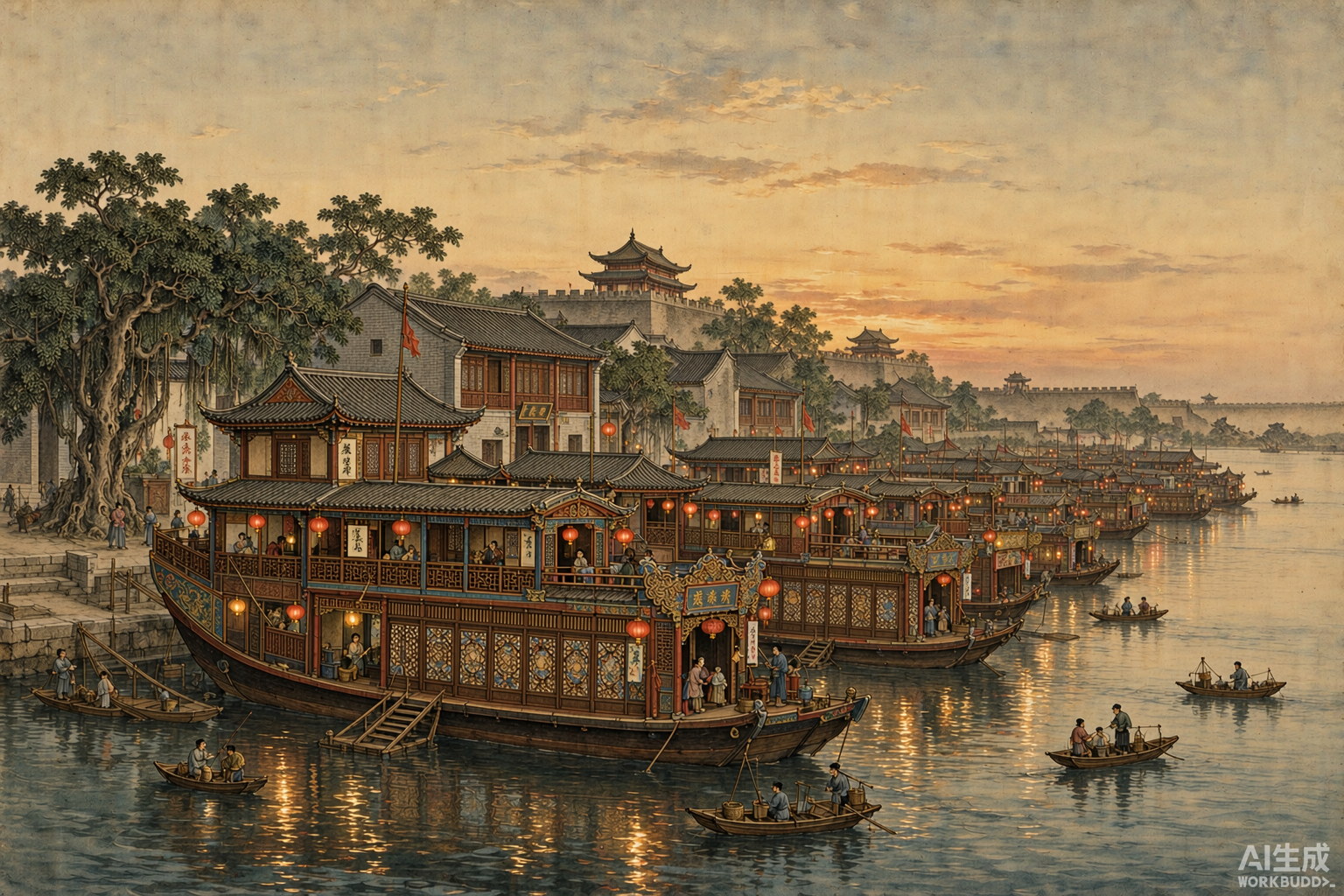
On the Pearl River, there were boats called 'flower boats.' They didn't sell flowers. They sold something else.

On the Pearl River, there were boats called "flower boats."
They didn't sell flowers.
They sold something else — something more expensive, and more dangerous.
What a flower boat was
A flower boat — hua chuan — was also called a zidong ting. It was a floating restaurant and brothel on the Pearl River in the Qing dynasty.
The name comes from a person. In the late Ming and early Qing, an official from Zidong village in Nanhai, Mai Yaoqian, built a large boat to travel to the provincial capital. It was tall and richly decorated. Wealthy families copied it. That is how the name zidong ting came about.
By the mid-to-late Qing, these boats had become the most luxurious floating restaurants and brothels on the river. People called them "flower boats."
Why on the water?
Because Guangzhou was the only port in China open to foreign trade.
During the Qianlong period, the Qing government restricted all foreign trade to Guangzhou. The hong merchants of the Thirteen Factories, foreign traders, and local officials all needed a place to meet, socialize, and spend money. But space inside the city walls was limited, and Xiguan outside the walls was not yet fully developed.
So dining, entertainment, and lodging all moved onto the river.
At the same time, early Qing coastal evacuation policies pushed many Tanka boat people — who had lived by fishing along the coast — inland to Guangzhou. They gathered on the Pearl River and lived on their boats. The spending power of the rich, plus the boats of the Tanka, created a "floating city" on the water.
How luxurious were they?
The zidong ting were top-tier for their time.
The hulls were wide, fitted with carved glass panels. They had kitchens, salons, and singing girls.
The larger ones had two stories and several halls, and could seat sixty tables of guests.
A single night cost at least ten yuan. At that time, an ordinary family earned only two or three yuan a year.
The merchants of the Thirteen Factories, foreign traders, and local officials were all regular guests.
The floating city
The flower boats on the Pearl River were moored in long rows. Between them ran "water streets" where small boats could pass. Boats selling fruit, food, and incense came and went all night. It was a true floating city that never slept.
1909: the fire
The end of this floating city came with a fire.
On the ninth day of the first lunar month in 1909, at the Dashatou pier in Guangzhou, a Guangxi official named Li Yizhi was drinking and enjoying himself on a flower boat. He knocked over a kerosene lamp. The oil ran through the gaps in the deck into the lower cabin and ignited instantly.
The flower boats were moored side by side. One caught fire, and the flames spread quickly to the next. Firefighting was poor — the water police even blocked civilian boats from approaching to help. The fire was out of control.
In the end, the fire destroyed 61 flower boats and killed nearly a thousand people. Among the dead were not only prostitutes and clients, but also officials, bankers, and merchants.
After the floating city
After the fire, public pressure was enormous. The Qing government removed the head of the water police for failing to rescue people, and ordered all flower boats at Dashatou to move ashore. The era of river-based entertainment declined from that point.
The "floating city" that had drifted on the Pearl River for more than a hundred years sank into history with this fire.
Closing
Flower boats didn't sell flowers.
They sold the most prosperous — and most dangerous — thing in Guangzhou at that time.
Not sure which element is missing from your chart? Take the free Five Elements test at wuxingvibe.com/reading — it takes 60 seconds, and it tells you which stones are for you.
Find your element
Take the free Five Elements test