Feng Shui is not magic. It’s about how your space makes you feel.
Feng shui is not about incense or mysterious rituals. It starts with one simple question — do you actually feel good in this room? The same is true of the Five Elements and crystals: they are tools for noticing what you lack and gently restoring balance.
When most people hear the words feng shui, they picture someone burning incense, moving a chair into a lucky corner, and hoping money suddenly appears. That image is dramatic, but it misses almost everything feng shui is really about.
One honest question
Real feng shui begins with something much simpler. It asks: when you sit in this room, how does your body feel?
Do you breathe a little more easily, or do you quietly tense up? Is there a place you actually want to spend time, or do you walk in and immediately want to leave?
That is not magic. It is attention.
Your desk tells the truth
Think about a desk pushed flat against a wall. You sit down, and there is nothing in front of you except a blank surface close to your face. Your view is blocked before you even start working.
Without knowing why, you can feel cramped. Ideas feel slow. Getting started feels heavy.
Now imagine the same desk turned so you can see the room and the door. Nothing supernatural has changed, yet something shifts. You feel a little safer, a little more open.
Clutter is a physical feeling
A bedroom piled with clothes, boxes, and half-finished projects works the same way.
Every object asks for a little bit of your attention, even when you are not looking at it. Your eyes keep finding the mess. Your nervous system quietly reads the room as unfinished, and it is harder to truly rest.
A dark hallway is another example. You walk through it and your body becomes slightly more alert. Good lighting does the opposite — it softens you before you ever think about why.
This is your nervous system, not a ghost
Here is the part that surprises people. None of this requires believing in anything unseen.
Your nervous system is constantly reacting to your environment. Open views create one feeling. Low ceilings and blocked corners create another. Warm light calms you down. Cold, sharp, crowded spaces keep you on guard.
Feng shui was studying these effects long before modern psychology gave them names.
The Five Elements work the same way
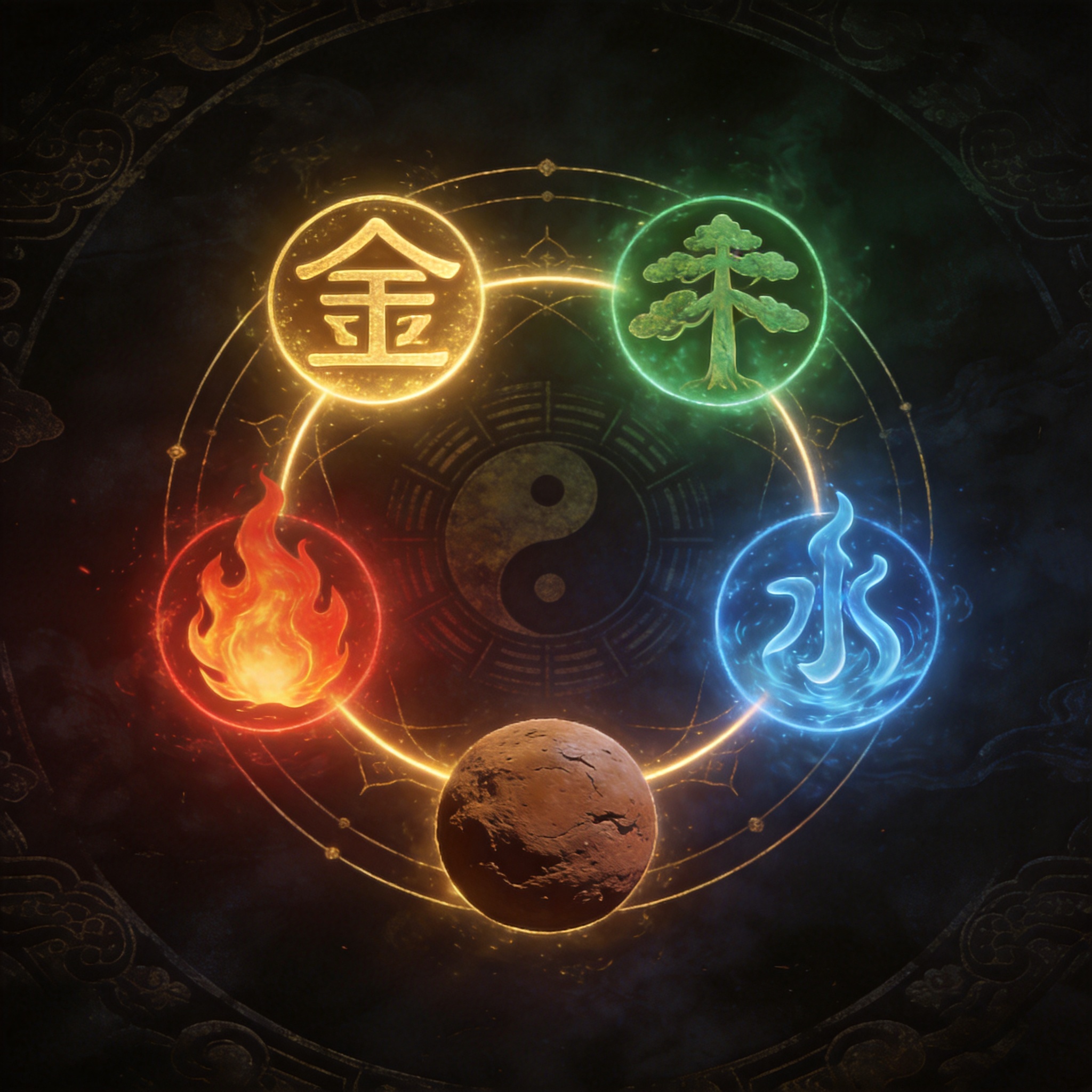
The Five Elements — Metal, Wood, Water, Fire, and Earth — are not a religion either. Think of them as a language.
They describe different qualities you need in order to feel whole: clarity, growth, flow, warmth, and stability. When one of those is missing, you feel the gap, even if you cannot explain it.
Maybe you feel stuck and lack direction. That is often described as low Wood energy. Perhaps you feel ungrounded and unsafe, which points toward Earth. Maybe you feel cold, flat, and low in motivation, which points toward Fire.
The system does not ask you to trust anything strange. It simply helps you notice what is depleted and how you might restore it.
Crystals are just one tool
This is where crystals enter the picture — and they are only one tool among many.
A clear, bright stone can support focus. A soft green stone can encourage a sense of growth. A warm, golden stone can lift a flat mood. A dark, grounding stone can help you feel steadier.
A crystal does not rearrange your life for you. But sitting on your desk or worn on your wrist, it is a small, steady reminder of the state you want to return to.
That reminder changes how you carry yourself, one decision at a time.
Begin with how you feel
So forget the image of complicated rituals. Feng shui is not about forcing luck. It is about shaping a space that lets your nervous system settle.
And the Five Elements are simply a way to ask the same question inwardly: what do I need more of right now?
Take the free Five Elements test to find your element.
Curious which element you need? Take the free Five Elements test to find your element.
Take the free Five Elements test →