Duanwu, the Dragon Boat, and Qu Yuan: Three Things, One Story
The festival now called the Dragon Boat Festival is known in Chinese as Duanwu. It began as a day to ward off disease — long before dragon boats, and long before Qu Yuan. This is the story of how the three became one.
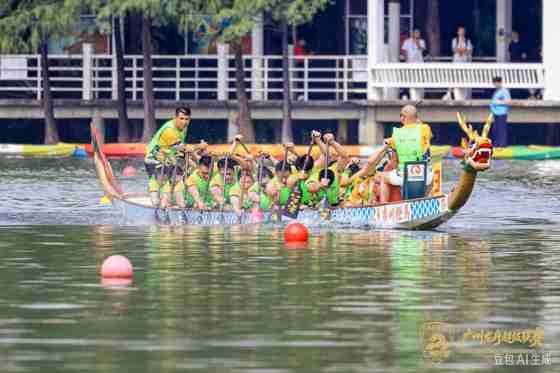
The festival now called the Dragon Boat Festival is known in Chinese as Duanwu. It began as a day to ward off disease — long before dragon boats, and long before Qu Yuan. This is the story of how the three became one.
The festival now called the Dragon Boat Festival is known in Chinese as Duanwu.
It began as a day to ward off disease — long before dragon boats, and long before Qu Yuan. This is the story of how the three became one.
1. The festival is older than the poet
Duanwu is older than Qu Yuan.
In the pre-Qin period, the fifth month was considered an "evil month," and the fifth day of the fifth month was an "evil day." People hung mugwort and calamus, drank realgar wine, and did what they could to ward off disease and bad luck.
This had nothing to do with Qu Yuan, and nothing to do with dragon boats. The festival began as a day to drive away illness.
2. Qu Yuan walked into the river
Qu Yuan was a nobleman of the state of Chu during the Warring States period, and one of China's greatest poets. He argued for reform and for an alliance with other states against Qin. His ideas threatened the old aristocracy. He was slandered, pushed out of court, and sent into exile.
In 278 BCE, the Qin army captured Ying, the capital of Chu. When Qu Yuan heard the news, he was overcome with grief. On the fifth day of the fifth lunar month, he walked into the Miluo River, holding a stone, and drowned himself.
When the people heard, they rowed out in boats to save him. They rowed fast. They searched everywhere.
They never found him.
To stop the fish and shrimp from eating his body, they threw rice balls into the river. Later, to keep the rice from being taken by dragons, they wrapped it in bamboo leaves and tied it with colored thread. That is how zongzi came to be.
3. Why remember him
Qu Yuan was not exiled because he failed. He was exiled because he refused to compromise.
He argued for reform, and offended the old nobility. He argued for an alliance with other states, and offended the lobbyists of Qin. He was honest, and made others look dishonest. He was capable, and threatened the positions of others. He held to his principles, and refused to go along with what was wrong.
He was exiled. He was no longer in court. But he was still a man of Chu.
In 278 BCE, the capital fell, and the ancestral temples of Chu were destroyed. For Qu Yuan, this was not a change of government. It was the end of his world.
He could not save Chu. But he could decide how he would face its fall.
He chose not to live as a man of a fallen state.
That is why, more than two thousand years later, Chinese people still remember him. Not because he succeeded, but because he never lowered his head.
4. How the three became one
The link between Duanwu and Qu Yuan goes back to the Eastern Han dynasty.
In the Customs and Traditions by Ying Shao, there is a line: "On the fifth day of the fifth month, people tie colored silk on their arms to ward off soldiers and ghosts, so they do not fall ill. This is also because of Qu Yuan."
That is the earliest known record connecting Qu Yuan to the festival.
By the Southern Dynasties, the connection was written clearly.
In Supplementary Records of the Qi Tradition, Wu Jun wrote: "Qu Yuan drowned himself in the Miluo River on the fifth day of the fifth month. The people of Chu mourned him, and on this day every year, they filled bamboo tubes with rice and threw them into the water as an offering."
In the same period, Records of the Seasons of Jing and Chu says: "The boat race on the fifth day of the fifth month is held because it is the day Qu Yuan drowned in the Miluo River. People grieve for his death, so they row out in boats to save him."
Note the timeline: Qu Yuan died in 278 BCE. The Southern Dynasties were in the 5th and 6th centuries CE. That is more than seven hundred years later.
The boat races and the rice dumplings already existed. It was people seven centuries later who explained them as being "for Qu Yuan."
After the Tang dynasty, the image of Qu Yuan as a patriot was reinforced by officials and writers. "The festival is for Qu Yuan" became the most widely told version, and it has stayed that way ever since.
5. Dragon boat today: three kinds
Today, the festival has dragon boats and zongzi. But in Guangzhou and Foshan, the dragon boat is three different things.
6. The international race

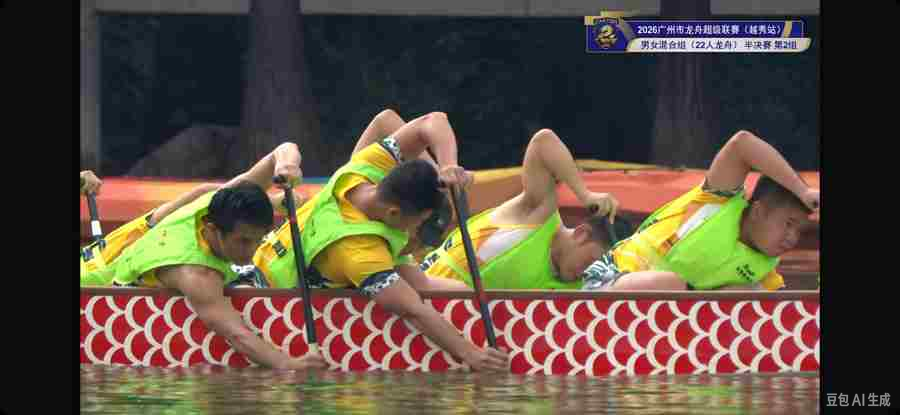
The Guangzhou International Dragon Boat Invitational is held on the Pearl River, between the north gate of Sun Yat-sen University and the Guangzhou Bridge. It began in 1985. More than forty years later, it is still going.
In 2026, the race brought together 105 teams and more than 3,800 athletes from 20 countries and regions. Beyond the districts of Guangzhou, there were teams from Chongqing, Jilin, Foshan, and Dongguan — "crossing-the-river dragons," as they are called. There were teams from Hong Kong and Macau. There were teams from Australia and Kazakhstan.
The main event is the 22-person, 600-meter straight race. But the more Cantonese part is the parade of "colorful dragons" and traditional dragon boats — decorated, slow-moving, and surrounded by crowds.
This is the dragon boat of the city: open, loud, and facing the world.
7. The village visit
This part of Guangdong is not a plain. It is a water network.
The Pearl River flows through here, splitting into countless rivers, creeks, and channels. These waterways connect village to village. In the past, outside the city walls of Guangzhou and Foshan, there was no city. There were only villages. Between one village and the next, there was water.
So the dragon boat here was not just a race. It was a road between villages.
In the old days, if you wanted to go from one village to another, you went by water. The dragon boats of Duanwu followed these waterways, visiting one village after another. When they reached a village, they would stop, greet the people, and offer blessings. This was not a performance. It was a visit.

Before the race, the team carries the dragon head and tail through the villages, beating drums and gongs, offering blessings to every household. This is called you long — "wandering dragon" — or bai cun — "visiting the villages." Villagers place food in baskets as a return gift.
After the race, the whole village gathers for the "dragon boat meal." The meal started as a way to feed the rowers — rice and dishes mixed together, easy to eat and full of energy. Over time, it became a feast to pray for strength and good fortune.
The most moving story in this tradition is the bond between the old dragon of Yanbu and the young dragon of Pantang.
In the Ming dynasty, during a race, the old dragon of Yanbu was about to win. But a rower from Pantang leaped up and grabbed the flag, winning the roast pig prize by the rules. The people of Pantang felt they had not won fairly, and tried to return the prize. The people of Yanbu felt Pantang had earned it, and refused to take it back. In the end, the two villages became qi ye and qi zi — godfather and godson. The bond has lasted more than five hundred years.
This is the dragon boat of the clan: about ritual, and about the relationship between villages.
8. The Dijiao drift
In Dijiao, a water town in Nanhai, Foshan, the dragon boat takes on a completely different character.
The canals here are famous for being crooked — "nine bends and thirteen turns." The narrowest point is only 3 meters wide. But the dragon boats are 25 meters long.
To navigate a bend at speed, the boat has to drift. The stern slides sideways. Water sprays. The boat comes within centimeters of the bank. It looks like a race car drifting around a corner. People call it the "Water F1."
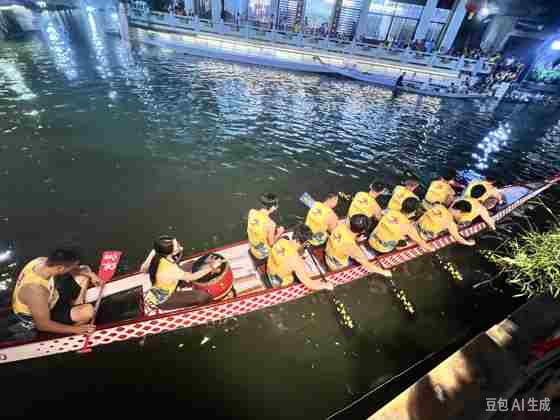
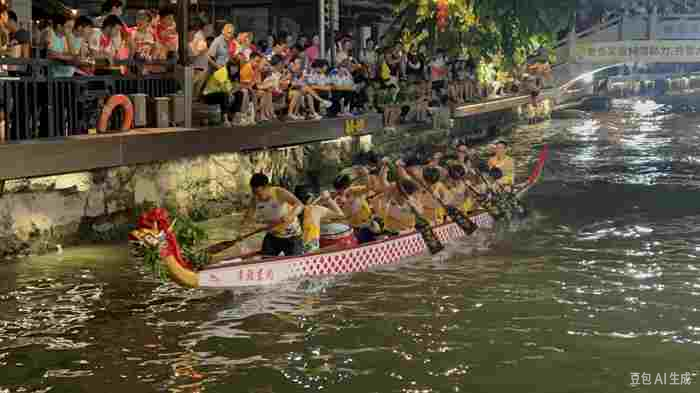
There are four race zones in Dijiao: the S-bend at Dongsheng, the L-bend at Shengtang, the C-bend at Tantou, and the J-bend at Chaji. At the tightest points, the boat has to skim along the bank. One mistake, and it crashes.
The local saying is "Ning ke bao lan, bu ke pa man." It means: "Better to crash than to slow down."
The rowers are all villagers. What used to be a visit between villages has become a race between villages.
This is the dragon boat of the water town: about skill, nerve, and competition.
Closing
Duanwu is the day. The dragon boat is the ritual. Qu Yuan is the man.
Three things, one story.
The international race is about the city, and its openness to the world. The village visit is about ritual, and the bond between clans. The Dijiao drift is about skill, and the nerve of the water town.
But all three come from the same story: more than two thousand years ago, a man walked into a river, and people rowed out to save him. They did not save him. And every year since, Chinese people have rowed out again.
Not to save him. To remember him.
Find your element
Take the free Five Elements test