The City God: A God Chosen From Among the Living
The City God is not a born god. He is chosen. A person who did something for a city while alive, and was remembered after death, becomes the City God of that city.
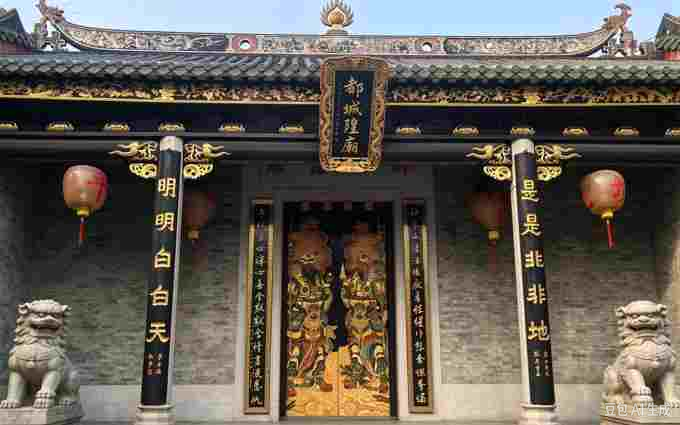
The City God is not a born god. He is chosen. A person who did something for a city while alive, and was remembered after death, becomes the City God of that city. This is what makes him different from most gods.

The City God is not a born god. He is chosen.
A person who did something for a city while alive, and was remembered after death, becomes the City God of that city. He is not sent down from heaven. He is chosen from among the living.
That is what makes him different from most gods.
The place where the City God is worshipped
The place where the City God is worshipped is called a City God temple — Chenghuang Miao.
It is a Daoist temple. It is not the same as a Buddhist si.
In China, many people say "temples" as one word. But si (寺) and miao (庙) are two different systems.
Si was originally the name of a government office. The "Court of Judicature" you hear in historical dramas — Dali Si — was the highest office for criminal justice. Later, when Buddhism entered China, emperors provided places for monks to practice, and these places were called si. Over time, si became the word for a Buddhist temple.
Miao is different. It was originally a place for ancestral sacrifices — like the emperor's "Grand Temple." After the Han dynasty, miao moved into the folk world and became a place for worshipping gods and sages. The Guan Yu temple, the Earth God temple, the City God temple — all of these are miao. Most of the gods in them belong to the Daoist system.
So when you see a si, it is usually Buddhist, and the offerings are fruit and flowers. When you see a miao, especially a City God temple, it is usually Daoist, and the offerings include meat — chicken, pork, fish. This is not random. It comes from two different sacrificial traditions.
What is a City God?
The two characters say it plainly. Cheng is the city wall. Huang is the moat. Together: wall and moat — the most basic defense of a city.
Later, it became a god. And this god manages everything in the city.
Not just the dead. The living too.
In an old county town, the magistrate handled the affairs of the living: taxes, lawsuits, roads, disaster relief. But there was so much he could not handle — floods, plagues, bandits, wrongful convictions. For these, people turned to the City God.
The City God protects the city. He keeps the peace, guards against floods, and judges fairly. He also manages the underworld: when a person dies, their soul reports to him, and he judges what they did in life.
He is the local official of both the living and the dead. In life, you ask him for protection. In death, you ask him for fairness.
How the City God is chosen
This is what makes the City God different. He is not hereditary. He is not sent down from heaven. He is chosen from among the living.
Many City Gods were real people. They served as officials in the city, or did good there, and after they died, the people of that city made them the City God.
First, Guangzhou: the exception, and there are three
Most City God temples in China have one main deity. Guangzhou is different. The Guangzhou City God Temple has three.
In the center: Liu Yan. He was the founding emperor of the Southern Han kingdom during the Five Dynasties and Ten Kingdoms period. Locals call him "Emperor Liu." His historical reputation is not good — he was known for extravagance and cruelty. So why is he the main deity of the Guangzhou City God Temple? After the Southern Han fell, the people who remained used the City God Temple to make images of him and offer sacrifices. Over time, he became the main deity. He was cruel, but he also played a part in stabilizing and building Lingnan during a time of war. When Guangzhou people worship him, it is less about morality and more about the fact that he was one of their own — the emperor of this city.
On the left: Hai Rui. A famous honest official of the Ming dynasty, from Qiongshan in Guangdong (now part of Hainan). He was known for his integrity and for standing up to the powerful. People called him "Hai the Blue Sky." Hainan was part of Guangdong at the time, so Guangdong people have always been proud that someone like Hai Rui came from their region.
On the right: Yang Jisheng. A loyal official of the Ming dynasty. He was killed after impeaching the powerful minister Yan Song. His famous line — "Iron shoulders carry morality, sharp hands write essays" — is still quoted today.
The Guangzhou City God Temple is the "Capital City God Temple of Guangdong," overseeing the whole province. In the Yongzheng era of the Qing dynasty, it stood on equal footing with the capital City God Temple in Beijing. The reason Guangzhou has three City Gods is that all three are directly connected to Guangdong and Guangzhou — Liu Yan was the emperor of Southern Han, Hai Rui was from Guangdong, and Yang Jisheng was a kindred spirit of Hai Rui. Guangzhou people put them together to say: "who is connected to this city," not "who is the most moral."
Then, other cities: one temple, one god
Most City God temples in China have one main deity. And each one has a specific story.
Hangzhou: Zhou Xin. A Ming official known as "Cold Face and Iron Heart." He was upright and unafraid of the powerful, and was later wrongly killed by the Yongle Emperor. Before he died, he shouted: "In life, a straight minister. In death, a straight ghost." After his death, the people of Hangzhou made him their City God.
Shanghai: Qin Yubo. A man of the late Yuan and early Ming. He served as an official, was known for his integrity, and managed flood control. After he died, he was made the City God of Shanghai.
Xi'an: Ji Xin. A general under Liu Bang. During the Chu-Han war at Xingyang, he disguised himself as Liu Bang to help him escape, and was burned alive by Xiang Yu. After Liu Bang became emperor, he honored him. Later, Ji Xin was made the City God of Xi'an, and the Xi'an City God Temple oversaw the whole northwest.
Wuhan: Yue Fei. Yue Fei was stationed in Wuchang for seven years, and the main camp of the Yue army was there. Emperor Shenzong of the Ming dynasty named him "Martial Sage Emperor," and the Wuchang City God Temple enshrined him. After the temple was rebuilt in 2014, the City God is still Yue Fei.
Nanjing: Jiang Ziwen. Jiang Ziwen was a commandant of Moling in the late Han dynasty. During the Three Kingdoms period, he was worshipped as the guardian of Nanjing. After Zhu Yuanzhang made Nanjing the capital, he named the Yingtian Prefecture City God an "Emperor" — an extremely high rank.
Fuzhou: Zhou Ke. Zhou Ke was a loyal official under Liu Bang. The Fuzhou City God Temple enshrines him. Later, officials like Cai Xiang and Tang He were also worshipped there. In the Yongzheng era of the Qing dynasty, the temple was granted the title "Capital City God of Fujian" — the highest City God in the province.
Nanchang: Guan Ying and Huang Gongqing. Nanchang has had two City Gods in its history. The first was the Han general Guan Ying, who built the Guan Ying city — the earliest recorded city wall in Nanchang. The second was the Ming official Huang Gongqing. He was honest in office, and after he died, people dreamed that he had become the City God. They reshaped his image to match.
Haikou: the prefecture and county City Gods together. The Haikou City God Temple enshrines two City Gods — the Qiongzhou Prefecture City God and the Qiongshan County City God. The original county temple fell into disuse, so the two were placed together in one temple. This is rare in China.
Every place has its own City God. But the logic is the same: do right in life, and the city will remember you.
If you travel to these cities
If you ever travel to these cities, there is one thing worth noticing.
In Hangzhou, look at the City God Temple on Wushan. It enshrines Zhou Xin. In Shanghai, look at the City God Temple. It enshrines Qin Yubo. In Xi'an, look at the City God Temple. It enshrines Ji Xin. In Wuhan, look at the City God Temple in Wuchang. It enshrines Yue Fei. In Nanjing, look at the City God Temple of Yingtian Prefecture. It enshrines Jiang Ziwen. In Fuzhou, look at the City God Temple. It enshrines Zhou Ke. In Guangzhou, look at the City God Temple. It enshrines three.
Every City God temple is a piece of memory for that city.
You do not need to read Chinese to understand one thing: this city remembered this person.
The couplet in the City God Temple
In most City God temples, there is a couplet that says it plainly:
If you do evil, burning incense will not help you. If your heart is upright, you don't need to bow to me.
It makes the point clear: it is not about worshipping. It is about how you live.
Closing
A person lives a hundred-some years. No one escapes death.
But in the City God temple, the people who are worshipped are the ones who, after death, were still remembered.
Not because they lived long. Because while they were alive, they did something for this city, and for the people in it.
If you want to be remembered, do good. Do good things.
That is the City God. He is not a born god. He is a person who was remembered.
Find your element
Take the free Five Elements test