What Chinese People Put on Their Doors, and Why
Red couplets on the sides. Two figures on the door. A '福' character pasted upside down. Many people think these are just decorations. In traditional China, they were a system — one that decided who could come in, and what should stay out.
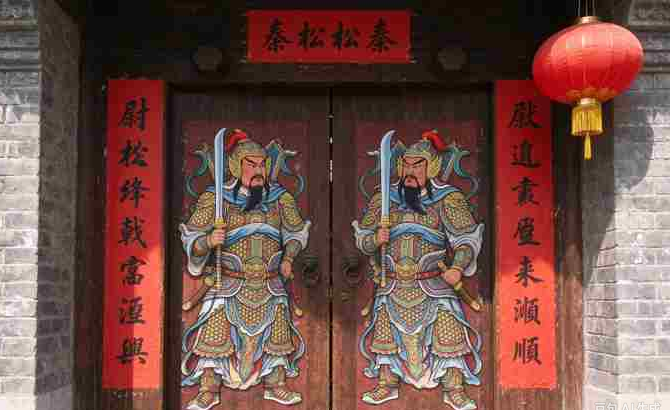
If you have spent Chinese New Year in China, or looked at an old Chinese house, you will notice something: the door is never empty.
If you have spent Chinese New Year in China, or looked at an old Chinese house, you will notice something: the door is never empty.
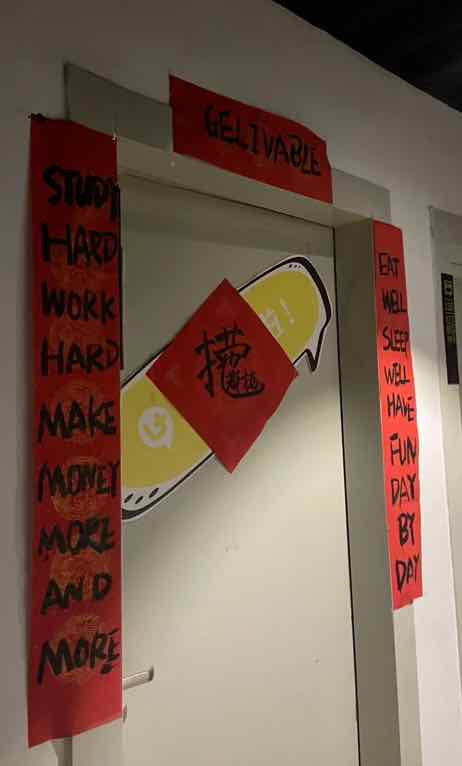
Red couplets on the two sides of the doorframe. Two figures pasted on the door itself — sometimes fierce, sometimes smiling. Sometimes a "福" character pasted upside down in the middle.
Many people think these are just decorations. But in traditional China, the door was a system. It decided who could come in, and what should stay out.
The door gods: two guards at the door
The door gods are images of people, pasted on the door.
They come in pairs — one on the left, one on the right, facing each other. Because a traditional Chinese door has two leaves, the door gods must also be a pair.
They look fierce for a reason. Folk belief says that with these two on the door, ghosts and spirits will not dare come near. They are symbols of righteousness and force. That is why they always have wide eyes and weapons in hand, ready to fight whatever comes up the steps.
Who the door gods are has changed over time
The earliest door gods were two brothers: Shen Tu and Yu Lei.
Legend says there was a giant peach tree on Mount Dushuo. To the northeast of the tree was the "gate of ghosts," where all ghosts came and went. Shen Tu and Yu Lei stood guard there. When they caught a ghost that harmed people, they tied it up with reed rope and fed it to a tiger. So people carved their names, or their images, into peach wood and hung them by the door.
By the Tang dynasty, the door gods had changed to Qin Qiong and Yuchi Gong.
The story goes like this. Emperor Taizong of Tang fell ill. At night, he heard ghosts crying outside his door and could not sleep. Two generals volunteered to stand guard at his door, fully armed. That night, it was quiet. The emperor did not want them standing there every night, so he had their portraits painted and hung on the palace door. The practice spread to the people, and that is how we got the door gods most people know today.

Civil door gods and martial door gods
Door gods are not only warriors.
Folk tradition divides them into martial door gods and civil door gods.
Martial door gods: Qin Qiong, Yuchi Gong, Guan Yu, Zhang Fei. They hold weapons, look imposing, and guard the house. They are used in places that are remote or feel "unsettled."
Civil door gods: Wei Zheng, Hai Rui, Bao Zheng, Wen Tianxiang. They are usually pasted on the doors of the main hall and the side rooms. They represent integrity, peace, and steady promotion.
There are also blessing door gods: the Three Stars of Fortune, Wealth and Longevity, the wealth-summoning boy, and the child-giving goddess. Shops paste the wealth ones. Families with elders paste the longevity ones. Families hoping for a child paste the child-giving one.
Choosing a door god is choosing what you want for your home.
The couplets: they came from peach wood
Couplets were not always called couplets. They were called tao fu — peach charms.
The ancient Chinese believed peach wood could ward off evil. The Zhuangzi says that if you put a peach branch by the door, ghosts will be afraid. From the Zhou dynasty onward, people hung rectangular peach wood boards on both sides of the door to drive away evil.
Later, people wrote auspicious phrases on the peach boards, or painted door gods on them. Then red paper replaced the peach wood, and matched sentences were written on the paper. That is how the couplet was born.
In the Five Dynasties period, the ruler of Later Shu, Meng Chang, wrote: "The new year brings surplus celebration; the fine festival is called long spring." Many people consider this China's first couplet. By the Ming dynasty, Zhu Yuanzhang ordered every household to paste couplets on New Year's Eve. That is when couplets spread across the country.
How to paste a couplet
A couplet is not pasted at random.
The upper line goes on the right. The lower line goes on the left. This is the direction you face when looking at the door. Because traditional writing goes from right to left, you also read the couplet from right to left.
How do you tell which line is upper and which is lower? Look at the last character. The upper line's last character is an oblique tone (third or fourth tone in Mandarin). The lower line's last character is a level tone (first or second tone). This is called ze qi ping shou — "rise on an oblique, close on a level."
Couplets are usually pasted in the afternoon or evening of New Year's Eve, and only after the whole family has gathered. The horizontal scroll goes first. Then the two sides. Then the "福" character.
The "福" character is often pasted upside down, because "upside down" sounds like "arrived" in Chinese — so fu dao le means "fortune has arrived." But the "福" on the main door is usually pasted right side up, out of respect.
Closing
What Chinese people paste on their doors is not just red paper.
The door gods ask: who can come in. The couplets say: what we hope comes in. The upside-down "福" says: fortune, please come in.
That small patch of red is a family's whole hope for the new year.
Find your element
Take the free Five Elements test